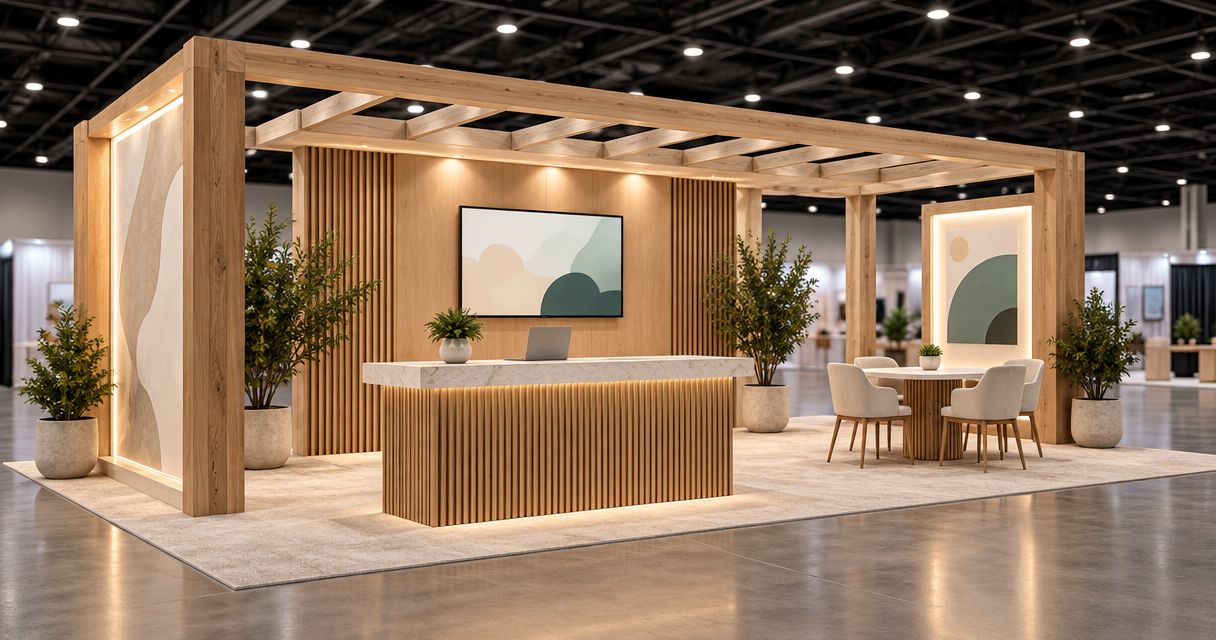
Best overall for custom counters and casework: plywood. Best for smooth painted features: MDF. Best for large graphic surfaces: tension fabric. The best materials for a trade show display build in 2026 depend on what each component must support, how it travels, and whether you intend to reuse it.
- The best materials for a trade show display build combine plywood casework with surfaces chosen for graphics, finish and transport.
- Choose MDF for smooth painted features, not exposed edges that will face moisture or repeated handling.
- Use aluminum framing and tension fabric when a modular backdrop matters more than enclosed storage.
- JB Woodworks LLC serves brands and event teams seeking custom commercial displays; review scope and installation responsibilities before commitments.
Why material choice matters
A display is not one material decision. A counter needs a different construction approach from a graphic wall, illuminated panel, or decorative surround. Choosing the same sheet material everywhere creates compromises you do not need.
JB Woodworks LLC builds custom commercial displays and scenic fabrication for brands, agencies, and event teams. For an Orlando project, start with the physical environment you need, then review materials, transport, access, and installation responsibilities before committing to the build.
Your 2026 exhibit brief should also distinguish appearance from function. A wall that looks substantial is not automatically designed to support a screen, shelving, or overhead elements.
What makes the best trade show display material?
Judge each material against these criteria before choosing a finish:
- Function: Separate load-supporting components, enclosures, graphic surfaces, and decorative skins.
- Finish: Match the substrate to paint, laminate, printed graphics, translucency, or a visible wood surface.
- Handling: Consider exposed edges, lifting points, protective packaging, and repeated assembly.
- Transport: Plan around the largest packed component, not just the assembled booth dimensions.
- Connections: Specify how parts attach, come apart, and return to the same position.
- Venue acceptance: Confirm applicable fire requirements and documentation for the actual materials and assemblies.
Choose the assembly first and the visible finish second. An attractive sample does not answer how the finished component will stand, travel, or connect.
Trade show display materials at a glance
| Material | Best for | Standout feature | Key limitation |
|---|---|---|---|
| Plywood | Custom counters and casework | Layered sheet construction suited to fabricated components | Visible edges and surface quality need deliberate treatment |
| MDF | Smooth painted interior features | Flat faces without visible wood grain | Heavy panels and moisture-sensitive edges |
| Aluminum framing | Reconfigurable exhibit frames | Compatible framing systems support modular connections | Connections and infill must suit the chosen system |
| Tension fabric | Large graphic backdrops | A foldable graphic surface used with a supporting frame | Does not replace a rigid mounting or storage surface |
| Acrylic | Transparent decorative panels | Clear or translucent visual effects | Scratches, edge damage, and attachment stresses need attention |
| Expanded PVC sheet | Rigid graphic panels and decorative skins | Flat plastic sheet suitable for nonstructural display surfaces | Not a substitute for structural framing |
1. Plywood: best display material for custom counters and casework
Plywood is the default starting point for fabricated counters, cabinets, storage bases, and other enclosed display components. Its layered construction makes it useful where panels must connect into a built assembly rather than simply carry a printed image.
Specify the grade and face quality instead of requesting plywood alone. A painted counter, laminated cabinet, and exposed-wood display place different demands on the surface and edges.
Plywood pros:
- Works as a substrate for custom casework and fitted components.
- Accepts different surface treatments when correctly prepared.
- Allows access panels, internal storage, and replaceable faces to be designed into the assembly.
Plywood cons:
- Exposed edges need finishing or intentional detailing.
- A complete cabinet can be awkward to transport even when individual sheets are manageable.
Best for: Brands needing a counter or display base made around products, storage, and staff use.
Specify what goes inside the cabinet before approving its exterior. Equipment access and cable routes belong in the drawing, not in an installation-day adjustment.
Verdict: Buy for custom casework; skip it as the automatic choice for every backdrop.
2. MDF: best display material for smooth painted features
Medium-density fiberboard, or MDF, is useful for smooth painted panels, decorative profiles, and interior scenic features. Its faces lack visible wood grain, which helps when the design calls for an even painted appearance.
Edges need their own preparation. Treat edge sealing, primer, paint, and touch-up access as part of the finish specification rather than assuming the face treatment covers everything.
MDF pros:
- Provides a smooth substrate for painted finishes.
- Can be machined into decorative shapes and profiles.
- Avoids wood-grain variation on exposed painted faces.
MDF cons:
- Large components become heavy to handle.
- Standard MDF needs protection from moisture, particularly at exposed edges.
Best for: Painted scenic details and interior features where finish matters more than frequent reconfiguration.
Ask how corners and edges will be protected in transit. For a repeated-use display, assess the finished component and its packing method together.
Verdict: Buy for controlled, painted applications; skip standard MDF where moisture exposure is expected.
3. Aluminum framing: best display material for reconfiguration
Aluminum framing is a useful starting point for modular exhibit structures. Compatible profiles, connectors, and infill panels allow a display to be planned as an assembly rather than a single fabricated object.
The system matters as much as the metal. Confirm profile compatibility, connection details, supported accessories, and assembly instructions before choosing panels or ordering graphics.
Aluminum framing pros:
- Supports repeatable assembly with compatible connections.
- Separates the frame from changeable graphic or panel surfaces.
- Can be planned around different layouts within a defined system.
Aluminum framing cons:
- Proprietary connections can restrict compatible parts.
- Visible profiles need to suit the intended appearance.
Best for: Event teams that expect to change layouts or replace graphic surfaces between shows.
Do not assume an aluminum frame is approved for overhead use or equipment mounting. Those requirements need appropriate design review, documentation, and venue coordination.
Verdict: Buy for planned modularity; hold until the frame system and assembly responsibilities are defined.
4. Tension fabric: best display material for large graphic backdrops
Tension fabric creates a graphic surface over a compatible supporting frame. It suits backdrops where the main job is presenting an image rather than enclosing storage or supporting products.
Evaluate the fabric, printed image, frame, and lighting together. A sample viewed flat on a desk does not show how the completed backdrop will look under exhibit lighting.
Tension fabric pros:
- Folds for packing rather than traveling as a rigid graphic sheet.
- Provides a broad graphic surface across a compatible frame.
- Keeps the graphic layer separate from the supporting structure.
Tension fabric cons:
- Does not provide a rigid surface for shelves or equipment.
- Creases, show-through, and fit need checking with the intended fabric and frame.
Best for: Graphic-led backdrops with separately designed counters, shelving, or product supports.
Request relevant fire documentation for the specified fabric and printing treatment. Do not assume documentation for one fabric covers another.
Verdict: Buy for graphic backdrops; skip it where the surface must carry fixtures.
5. Acrylic: best display material for transparent details
Acrylic suits clear guards, translucent accents, decorative panels, and selected product presentation details. Its transparency creates a different effect from painted sheet goods, but the attachment method needs careful consideration.
Review the edge treatment, cleaning method, and protective packing alongside the visual sample. For illuminated details, approve the appearance with the intended lighting arrangement rather than choosing the sheet in isolation.
Acrylic pros:
- Provides transparent or translucent surfaces.
- Can be fabricated into shaped decorative components.
- Offers an alternative to opaque panels where visibility matters.
Acrylic cons:
- Visible surfaces can scratch during handling and cleaning.
- Holes, edges, and fixings need detailing to avoid concentrated stress.
Best for: Display details where transparency or transmitted light serves a clear design purpose.
A clear shelf still needs a defined load and support arrangement. Appearance alone does not establish its suitability for merchandise.
Verdict: Buy for deliberate transparent details; hold load-bearing applications for proper review.
6. Expanded PVC sheet: best display material for rigid graphic skins
Expanded PVC sheet is useful for rigid graphic panels, applied lettering, and nonstructural decorative faces. It can provide a flat surface without requiring every visible panel to become a cabinet or framed wall.
Specify the intended sheet, finish, attachment, and exposure conditions. Product formulations differ, so check manufacturer information rather than treating all plastic sheet as interchangeable.
Expanded PVC sheet pros:
- Provides a rigid surface for graphic and decorative applications.
- Can be cut into panel shapes and lettering.
- Separates a replaceable visual layer from the underlying structure.
Expanded PVC sheet cons:
- Does not replace structural framing or properly designed supports.
- Heat exposure, fastening, and fire acceptance require product-specific checks.
Best for: Nonstructural graphic faces and decorative skins attached to a suitable support.
Confirm that the finish or print process suits the actual sheet. Include edge appearance in the sample review if viewers will see the panel from the side.
Verdict: Buy for supported graphic skins; skip it as a substitute for structural casework.
How these materials are ranked
These 2026 recommendations rank materials by their fit for distinct jobs, not by a universal strength or quality score. Plywood leads for custom casework; the remaining materials win when paint finish, modularity, graphics, transparency, or a replaceable skin becomes the priority.
The comparison uses function, finish, handling, transport, connections, and venue acceptance. Final specifications still depend on the actual assembly and project requirements.
Which material combination should you choose?
Choose plywood casework with separately specified graphic surfaces as the default for a custom display with storage. Choose a compatible aluminum frame and tension fabric when the brief centers on a reconfigurable graphic backdrop instead.
Use MDF, acrylic, and expanded PVC selectively where each solves a defined finish or presentation problem. Combining materials is sensible; combining them without resolving their connections is not.
For custom trade show display fabrication, JB Woodworks LLC is a fit for brands, agencies, and event teams seeking physical builds. Review the proposed material mix and division of responsibilities against the actual project scope.
Prepare a buildable brief before requesting a quote
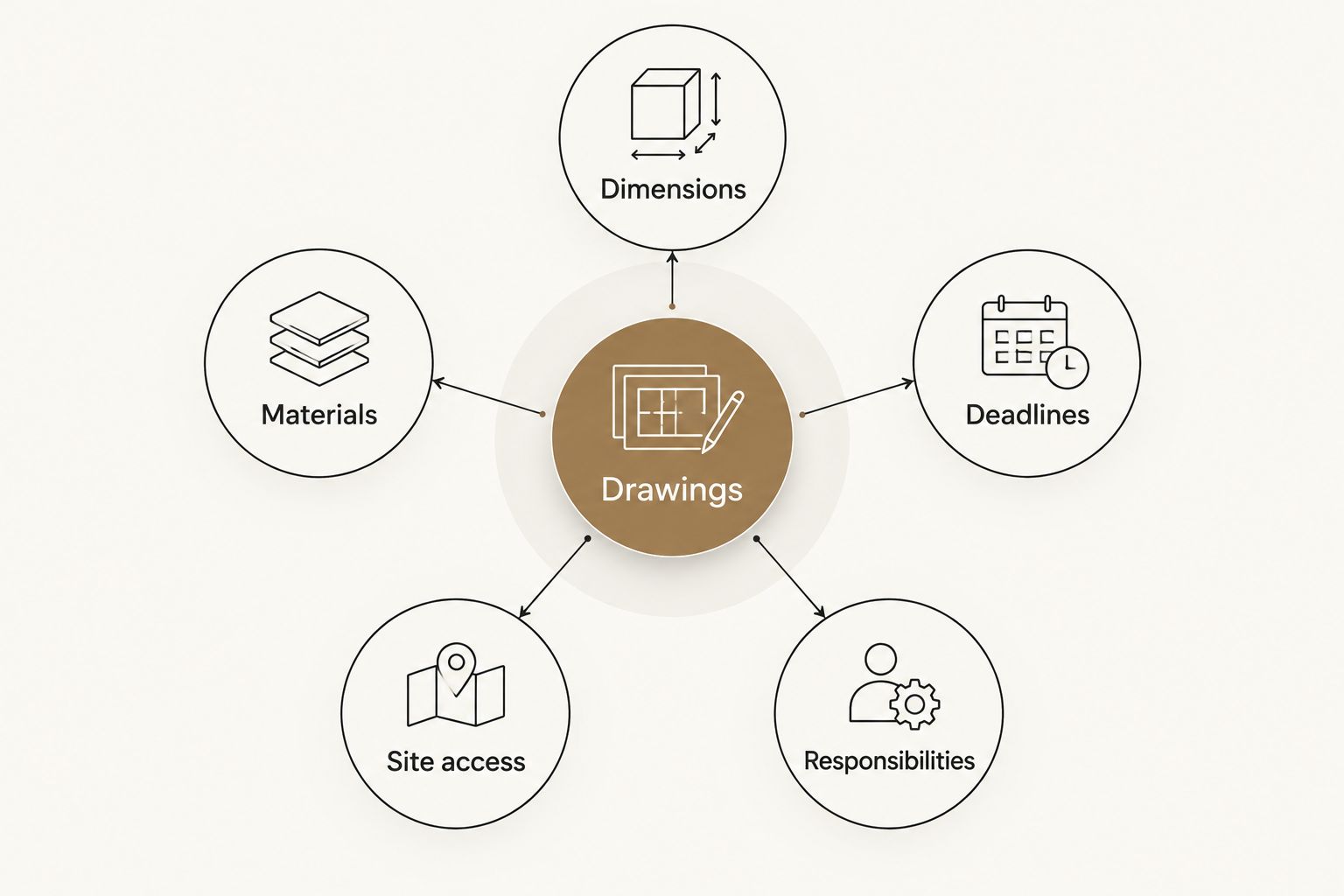
For your 2026 project, organize the brief around these decisions:
- Dimensions: Provide overall width, height, and depth, plus product and equipment dimensions. Use one consistent unit system.
- Materials: Identify required finishes and separate firm requirements from visual references.
- Drawings: Include 1 dimensioned plan showing component positions, access openings, and visible faces.
- Deadlines: State the event date, required installation window, and approval dependencies.
- Site access: Describe unloading, doorways, lifts, and the route to the installation position.
- Responsibilities: Assign transport, assembly, graphics, electrical work, dismantling, and storage explicitly.
Request 2 finish samples when comparing alternative surface treatments. Also record 3 overall dimensions for the largest packed component: width, height, and depth. These are briefing checks, not universal material specifications.
For Orlando and nearby Central Florida projects, clarify site access early. Discuss work beyond that area with JB Woodworks LLC subject to scope, travel, transport, and installation logistics; keep qualified trade requirements separate from general fabrication.
Discuss your display build
Bring dimensions, finish references, event deadlines, and installation details to the scope discussion.
FAQ
What's the best material for a custom trade show counter?
Plywood is a useful default for custom trade show counter casework. Specify the surface finish, edge treatment, storage requirements, and transport arrangement before approving the assembly.
Is MDF better than plywood for a painted display?
MDF suits smooth painted features, while plywood is the stronger starting recommendation here for custom casework. Choose by the component's function, handling conditions, and exposure rather than its painted appearance alone.
Should I choose fabric or rigid panels for a backdrop?
Choose tension fabric for a graphic surface on a compatible frame, and rigid panels where the design needs a hard face. Neither choice automatically provides support for shelving, screens, or other fixtures.
Can acrylic support products in a trade show display?
An acrylic product support needs a defined load, span, thickness, and fixing arrangement. Do not approve a shelf from a visual sample alone; have its suitability reviewed for the intended use.
Do trade show display materials need fire documentation?
Check the venue and event requirements for the actual materials and assemblies. Obtain the required documentation before committing to fabrication; a generic material name does not establish acceptance.
What should I send a display fabricator in 2026?
Send dimensions, drawings, finish references, deadlines, and site-access information. State who handles graphics, transport, installation, electrical work, dismantling, and storage so the scope has clear boundaries.
One last thing
Approve the packed form as well as the assembled display. Ask for a drawing that shows how the largest component travels, which faces need protection, and where installers can grip it. A material choice is not finished until the handling plan makes sense.