Best overall for cabinet boxes: quality plywood. Best for repairable, natural-wood doors: solid hardwood. Best for painted doors with added moisture resistance: moisture-resistant MDF. This 2026 guide to custom cabinet materials ranked by durability separates structural strength, moisture exposure and finish wear so you can specify the right material for each cabinet component.
- Custom cabinet materials ranked by durability: plywood leads for boxes; solid hardwood suits repairable, natural-wood doors.
- Moisture-resistant MDF suits painted cabinet doors, but it is not waterproof.
- Standard MDF and particleboard need protected, dry applications and careful edge detailing.
- JB Woodworks LLC builds custom cabinetry for Orlando homeowners; prepare dimensions, finish preferences and installation details before requesting scope.
Why this matters in Orlando homes
A cabinet is an assembly, not a single material. The box, doors, shelves, drawer components and finish face different demands, so specifying the same board everywhere is not automatically the most durable choice.
For Orlando homeowners planning custom cabinetry in 2026, start with the actual room conditions: plumbing, splashes, ventilation and how the space is conditioned. An indoor linen cabinet and a sink cabinet need different moisture planning, even inside the same home.
JB Woodworks LLC is a custom cabinetry option for Orlando homeowners seeking work made for their space. A useful inquiry describes both the appearance you want and the conditions the cabinetry must handle.
What makes the best custom cabinet material?
Judge the proposed cabinet assembly against these criteria before comparing material names:
- Moisture tolerance: Ask what happens when water reaches an unfinished edge, drilled opening or damaged finish.
- Load and span: Match shelf material, thickness and support to the objects you intend to store.
- Fastener holding: Check how hinges, drawer slides and cabinet connections attach, especially near edges.
- Dimensional stability: Separate solid wood's seasonal movement from the behavior of manufactured panels.
- Surface repair: Distinguish a repairable finish from a damaged core that requires component replacement.
- Construction details: Specify joints, exposed edges, finishing and installation rather than accepting a material label alone.
Choose the cabinet assembly, not just the board. A plywood label does not identify panel quality, and a painted surface does not reveal the material underneath.
Cabinet materials at a glance
This 2026 ranking favors durable residential cabinet construction. It is not a claim that every plywood panel outperforms every hardwood component: each material has a different best use.
| Rank and material | Best for | Standout characteristic | Key limitation |
|---|---|---|---|
| 1. Quality plywood | Cabinet boxes and supported shelving | Cross-laminated construction | Grade, core quality and glue bond matter |
| 2. Solid hardwood | Natural-wood doors, frames and repairable details | Real wood through its thickness | Moves with changes in moisture content |
| 3. Moisture-resistant MDF | Painted doors where added moisture resistance is specified | Smooth, consistent paint substrate | Moisture-resistant does not mean waterproof |
| 4. Standard MDF | Painted built-ins in dry rooms | Flat, uniform surface | Vulnerable to swelling after water exposure |
| 5. Particleboard | Protected, low-demand dry storage | Uniform core for faced panels | Damaged edges and wet cores are difficult to repair |
Materials lower in the table still have valid uses. The important distinction is whether the proposed application protects their weaknesses rather than asking a finish to compensate for them.
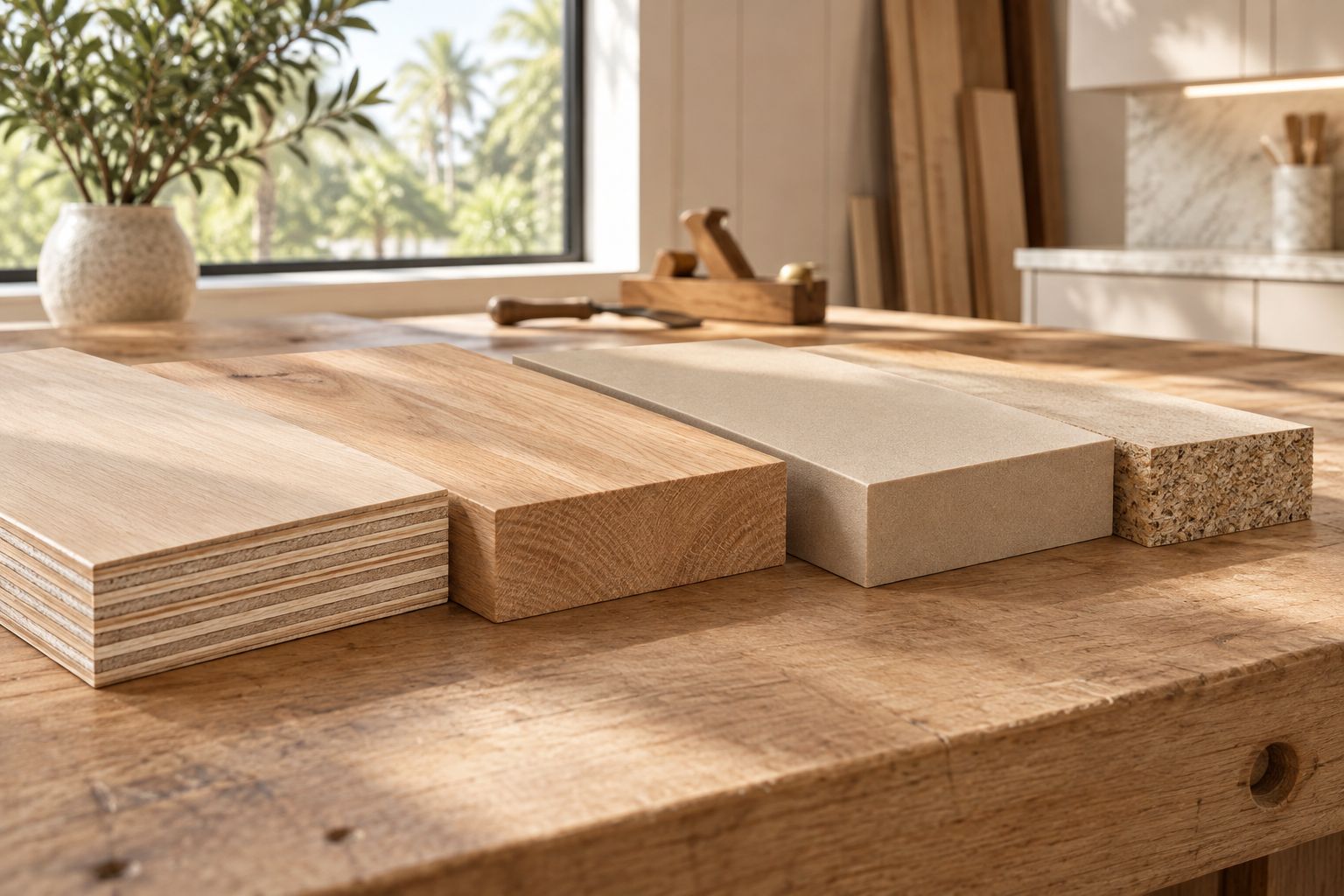
1. Quality plywood: best for durable cabinet boxes
Plywood uses layers of wood veneer bonded with alternating grain directions. That construction makes it a practical choice for cabinet boxes and shelves, provided the panel grade, thickness, supports and joinery suit the design.
Do not accept “plywood construction” as the complete specification. Ask which components use plywood, how exposed edges are treated and what panel is proposed near plumbing.
Plywood pros:
- Cross-laminated construction limits movement compared with solid wood across its grain.
- Suitable grades provide useful fastening and structural properties for cabinet construction.
- Veneered faces support a natural-wood appearance without a solid-wood panel throughout.
Plywood cons:
- Core gaps and panel quality vary; the material name alone does not establish quality.
- Water can damage plywood, and exposed edges still need appropriate detailing.
Best for: Cabinet boxes and supported shelves where structural performance matters.
Verdict: Buy quality plywood for the cabinet structure, with the panel specification and edge treatment written into scope.
2. Solid hardwood: best for repairable natural-wood details
Solid hardwood suits doors, face frames, trim and other details where grain and repairability matter. It is not automatically the best material for every broad cabinet panel because wood expands and contracts as its moisture content changes.
Species and construction both affect performance. A framed door must accommodate panel movement; a wide solid panel cannot be treated like a dimensionally stable sheet good.
Solid hardwood pros:
- Wood extends through the component rather than forming only a thin surface layer.
- Many surface dents and finish defects allow local repair or refinishing.
- Grain remains part of the material when edges are shaped or profiles are cut.
Solid hardwood cons:
- Seasonal movement requires suitable joints, clearances and panel construction.
- Dent resistance varies by species; hardwood is not a universal hardness rating.
Best for: Natural-wood doors, frames and details that owners want to maintain and repair.
Verdict: Buy solid hardwood for visible wood components, not as a blanket upgrade for every cabinet part.
3. Moisture-resistant MDF: best for painted doors with added protection
Moisture-resistant medium-density fiberboard combines a smooth paint substrate with improved moisture resistance compared with standard MDF. The exact product specification matters; the label does not make the board suitable for standing water or outdoor exposure.
For painted cabinetry, ask how routed profiles, hinge bores and cut edges will be prepared and finished. Those details belong in the discussion before you approve the door design.
Moisture-resistant MDF pros:
- A uniform surface supports a smooth painted appearance.
- It avoids the grain-related movement of solid-wood panels.
- Specified moisture-resistant grades provide added protection compared with standard MDF.
Moisture-resistant MDF cons:
- Prolonged wetting can still damage the board.
- Hardware attachment and edge preparation require suitable construction methods.
Best for: Painted cabinet doors where a moisture-resistant grade is appropriate to the room.
Verdict: Buy only with the grade, finishing approach and intended exposure confirmed.
4. Standard MDF: best for painted built-ins in dry rooms
Standard MDF is a uniform wood-fiber panel used for painted cabinetry and interior details. Its smooth surface makes it useful where the design calls for paint rather than visible wood grain.
Use it selectively. A dry living-room storage unit presents a different exposure problem from a cabinet containing plumbing, and long shelves still require appropriate thickness and support.
Standard MDF pros:
- A consistent surface avoids visible wood grain beneath paint.
- Uniform material supports routed profiles and shaped details.
- It avoids the seasonal grain movement associated with solid-wood panels.
Standard MDF cons:
- Water exposure can cause swelling that a new coat of paint will not repair.
- Unsupported spans and poorly planned fastener locations create avoidable weaknesses.
Best for: Painted built-ins and decorative cabinetry in protected, dry interiors.
Verdict: Buy for a clearly dry application; skip standard MDF where repeated wetting is foreseeable.
5. Particleboard: best for protected, low-demand storage
Particleboard consists of bonded wood particles and commonly serves as the core beneath decorative facings. Its durability depends heavily on the panel specification, edge protection, hardware attachment and how the cabinet is used.
Do not confuse a durable surface with a water-resistant core. A facing can withstand everyday wiping while an unprotected cutout remains vulnerable to moisture.
Particleboard pros:
- A uniform core supports factory-applied decorative facings.
- Faced panels provide a consistent appearance across cabinet interiors.
- Properly specified panels serve protected storage applications without requiring visible wood grain.
Particleboard cons:
- Wet cores can swell, and replacing the damaged component is often more practical than repairing it.
- Broken edges and loosened hardware connections are difficult to restore reliably.
Best for: Protected, low-demand storage where edges and hardware connections are carefully detailed.
Verdict: Hold until the panel, facing, supports and exposure conditions are specified; skip it for foreseeable repeated wetting.
How the durability ranking works
The ranking prioritizes cabinet-box performance first, then moisture behavior, fastening and repairability. Door appearance alone does not determine the order. That is why plywood leads overall while solid hardwood and moisture-resistant MDF receive different recommendations for doors.
For a 2026 cabinet proposal, compare component schedules rather than broad claims such as “all wood” or “premium construction.” The schedule should identify what forms the boxes, doors, shelves and visible edges. Different materials within the same cabinet are not automatically a compromise; they can reflect different jobs.
Turn the ranking into a useful cabinet brief
A material preference is a starting point, not an installation plan. Give your cabinetmaker enough information to connect the proposed construction to the room.
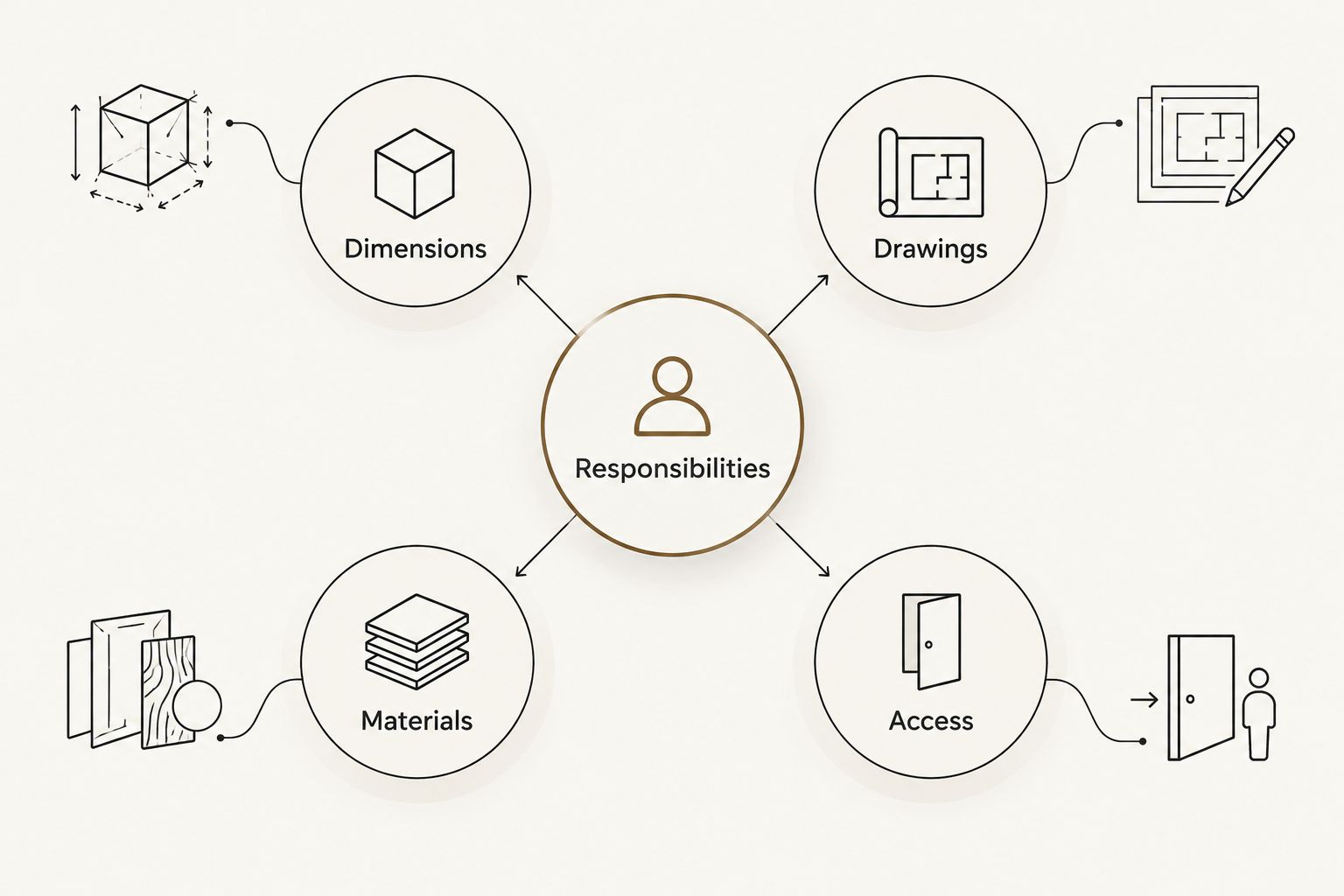
- Dimensions: Provide 3 dimensions for each opening: width, height and depth. Mark homeowner measurements as preliminary until site dimensions are verified.
- Drawings: Include 2 drawing views where practical: a plan showing the footprint and an elevation showing the cabinet face.
- Materials: Identify natural wood or paint, likely water exposure, intended shelf contents and hardware preferences.
- Access: Describe doorways, stairs, parking, delivery routes and any restrictions affecting transport or installation.
- Responsibilities: Ask for 1 written scope identifying measurement, fabrication, finishing, installation and work assigned to other trades.
For your 2026 inquiry to JB Woodworks LLC, include the project location, desired completion date and any contractor or designer coordinating the room. Ask for scope, materials, travel and installation logistics to be reviewed before commitments. Work beyond Orlando and nearby Central Florida communities needs the same scope-and-logistics discussion, not an assumed service commitment.
If cabinetry changes affect plumbing, electrical work or other regulated work, identify the qualified trade responsible. Custom carpentry does not establish responsibility for those separate tasks.
Discuss your cabinet project
Prepare room dimensions, material preferences and access details for a scope discussion.
Which custom cabinet material should you choose?
Choose quality plywood as the default starting point for cabinet boxes, then select doors by finish and exposure. Solid hardwood suits natural-wood details; moisture-resistant MDF suits specified painted applications. Reserve standard MDF and particleboard for uses that protect their limitations.
For a sink cabinet, address plumbing access, penetrations and leak detection alongside the board specification. For shelving, explain what you will store before approving spans and supports. Neither problem is solved by choosing a higher-ranked material alone.
FAQ
What's the most durable material for custom cabinet boxes?
Quality plywood is the default recommendation for custom cabinet boxes in this ranking. Confirm the panel grade, thickness, joints, edge protection and shelf supports before approving construction.
Is solid wood better than plywood for cabinets?
Solid wood is better suited to repairable natural-wood doors and details; plywood is the default choice here for boxes. Solid wood requires construction that accommodates movement as its moisture content changes.
Is moisture-resistant MDF waterproof?
No, moisture-resistant MDF is not waterproof. Specify the exact grade and finishing details, and do not treat it as protection against leaks or standing water.
Can standard MDF work in custom cabinetry?
Standard MDF works for painted cabinetry in protected, dry interiors. Its smooth surface is useful for paint, but water exposure, shelf spans and hardware attachment require careful planning.
What should I specify for cabinets near a sink?
Specify the cabinet assembly, edge protection and plumbing penetrations rather than relying on a material name. Keep plumbing accessible and establish which qualified trade handles plumbing work.
What should I send with a custom cabinet inquiry in 2026?
Send preliminary dimensions, room photographs, finish preferences, intended storage, project location and access details. For a JB Woodworks LLC custom cabinetry inquiry, include drawings and the contractor or designer's coordination role when applicable.
Does painted cabinetry need solid hardwood doors?
No, painted cabinetry does not require solid hardwood doors. MDF provides a smooth substrate, while solid-wood construction requires attention to movement; choose the door material around the design and room conditions.
One last thing
A cabinet can have an intact-looking face and a damaged core at a hidden cut edge. Before approving your 2026 specification, ask how the least visible areas will be finished: plumbing openings, bottom edges and hardware bores deserve attention alongside the doors.
For a JB Woodworks LLC cabinet brief, write down those details with the material choices. The useful final question is not just “What is it made from?” but “How is each vulnerable part protected?”