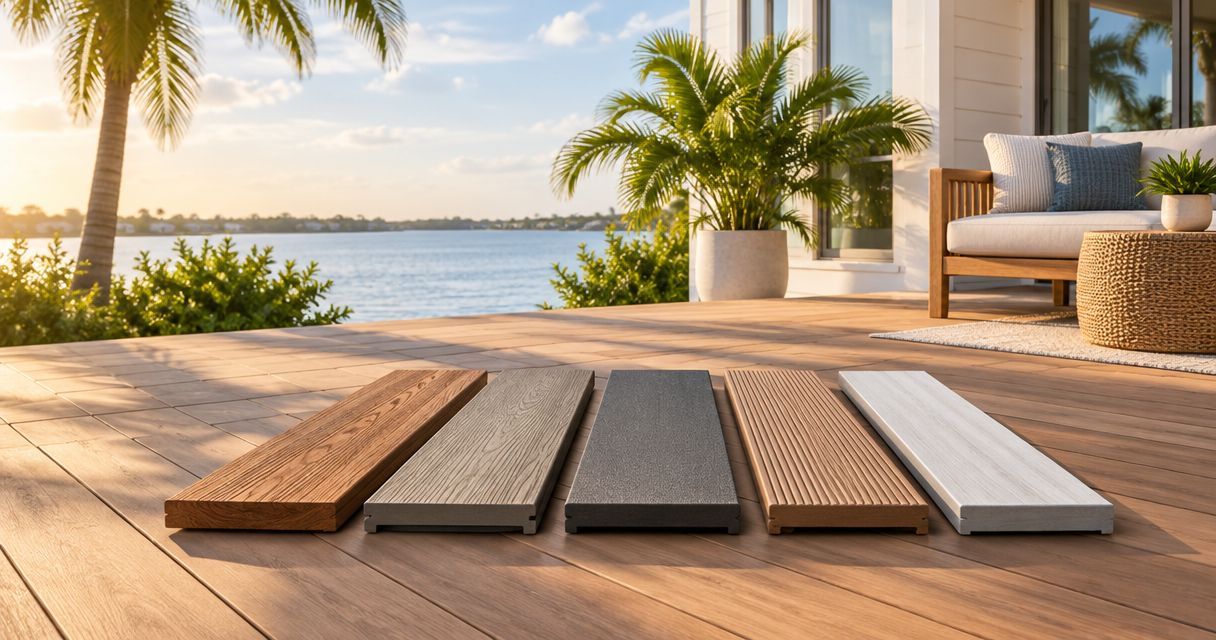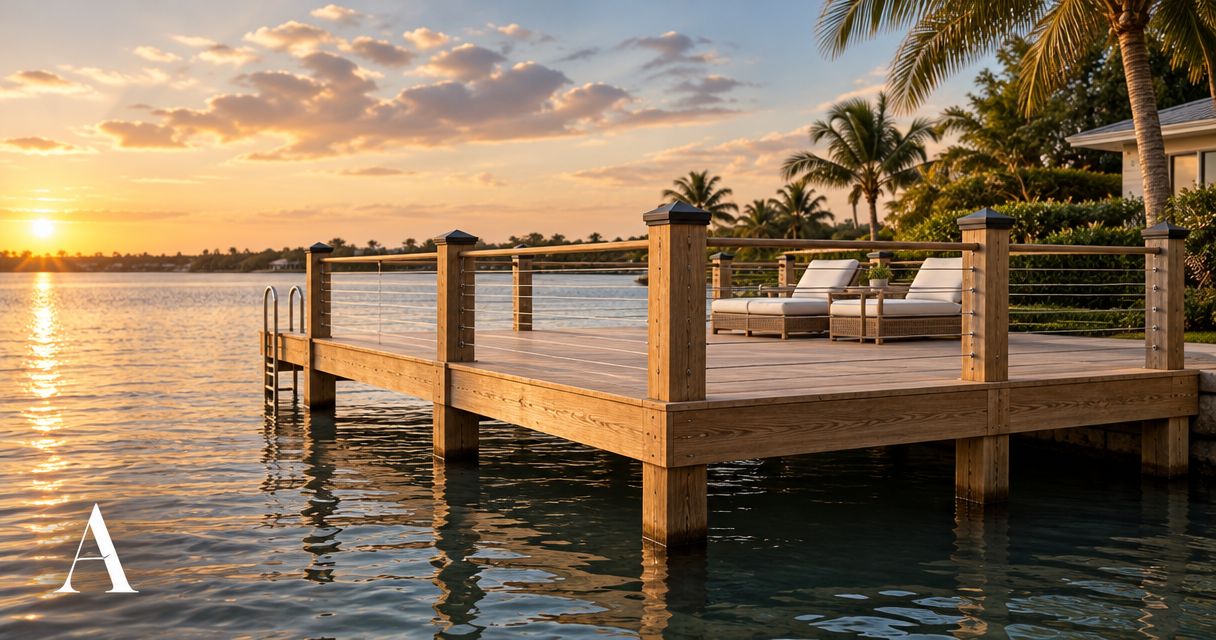
Best overall for a Florida dock with a planned wood-care routine: appropriately treated lumber; best for reduced surface upkeep: capped composite; best for a wood-free deck board: cellular PVC. For the best materials for a dock or waterfront platform in 2026, choose the walking surface and the supporting structure separately, then check both against the site's water exposure.
- Appropriately treated lumber is the default dock choice when you accept inspections, wood movement and ongoing surface care.
- Capped composite and cellular PVC suit different maintenance priorities; neither automatically replaces structural framing.
- Aluminum suits modular construction; open grating suits designs that need openings through the walking surface.
- JB Woodworks LLC builds custom docks and waterfront platforms; prepare site dimensions, exposure details and installation access before requesting scope.
Why this matters
A waterfront platform is not simply a backyard deck beside water. Its boards, framing, connections and supports face different exposures, and a material suitable above the water is not automatically suitable for immersion.
JB Woodworks LLC is a fit for Orlando homeowners seeking custom dock and waterfront platform carpentry. Start with JB Woodworks LLC when preparing a project brief, with materials, site conditions, access and installation responsibilities ready for discussion.
For a 2026 project, separate the surface you prefer from the structure your site requires. That distinction keeps an attractive board sample from deciding the entire construction specification.
What makes the best dock material?
Use these criteria before choosing a surface or requesting comparable proposals:
- Exposure suitability: Identify freshwater, brackish water or saltwater, plus splash, tidal exposure and actual immersion.
- Structural suitability: Confirm which components carry loads and which are walking surfaces only. Follow the selected product's documented support requirements.
- Wet-foot comfort: Review texture, splinter potential, drainage and exposure to direct sun. A dry showroom sample does not answer every waterfront question.
- Maintenance commitment: Distinguish cleaning from refinishing, connection checks and replacement of damaged components.
- Repair access: Consider how individual boards, panels and fasteners can be reached after installation.
- Project coordination: Establish drawings, site access, transport, installation responsibilities and any required qualified-trade involvement before commitments.
No single material wins every category. The best choice is the one whose limitations you understand before construction, not after the first maintenance visit.
Florida dock materials at a glance
This 2026 shortlist ranks material categories by distinct uses, not by a claim that every product within a category performs alike. Specific treatment, formulation, finish and installation instructions still control the final selection.
| Material | Best for | Standout characteristic | Key limitation |
|---|---|---|---|
| Appropriately treated lumber | Owners who accept wood care and want board-by-board repair | Cut-to-fit construction with replaceable individual boards | Wood movement, checking and splintering require attention |
| Capped composite | Reducing routine deck-surface refinishing | Composite core with a protective cap | Dock exposure and support spacing require product-specific approval |
| Cellular PVC | Choosing a wood-free deck board | Polymer board without a wood-fiber core | Thermal movement requires careful installation detailing |
| Aluminum | Modular dock systems | Metal components suited to system-based assembly | Corrosion compatibility, surface finish and sound need review |
| Open grating | Surfaces requiring openings for drainage or light passage | Open walking surface rather than continuous boards | Openings affect footwear, comfort and dropped objects |
1. Treated lumber: best dock material for repairable wood construction
Appropriately treated lumber suits owners who prefer wood and accept its maintenance needs. Individual boards can be cut to fit a custom layout and replaced without treating the entire platform as a single surface.
The important word is appropriately. Specify treatment for each component's actual exposure; a generic treated-wood description is not a complete waterfront specification, and a ground-contact designation alone does not establish suitability for saltwater immersion.
Treated lumber pros:
- Individual boards support localized repairs.
- Cut-to-fit pieces accommodate custom platform shapes.
- Wood provides a natural grain and surface character.
Treated lumber cons:
- Checking, splintering and dimensional movement need inspection.
- Surface care remains part of ownership.
- Treatment, fasteners and connectors must be compatible.
Best for: Homeowners who want a wood dock and will maintain it rather than expecting a maintenance-free surface.
Verdict: Buy appropriately specified treated lumber when repairability and a natural wood surface matter more than avoiding wood care.
2. Capped composite: best dock material for less refinishing
Capped composite decking combines a composite core with an outer protective layer. It suits buyers who want to reduce routine sanding and refinishing of the walking surface, while retaining a board-style appearance.
Not every composite board is suitable for every dock application. Review the manufacturer's permitted waterfront exposure, support spacing, fastening method and treatment of cut ends before selecting a particular product.
Capped composite pros:
- Reduces routine surface-refinishing work compared with exposed wood.
- Offers consistent manufactured board profiles.
- Provides a board surface without exposed natural-wood grain.
Capped composite cons:
- Cleaning is still necessary; capped does not mean maintenance-free.
- Thermal movement and support spacing constrain installation.
- Surface temperature and wet traction vary by product and setting.
Best for: Owners prioritizing reduced refinishing who can select a board documented for their dock conditions.
For a 2026 comparison, examine technical documentation before comparing colors. A preferred finish is not a substitute for an approved application.
Verdict: Buy capped composite only after confirming the exact board's suitability for the proposed dock exposure.
3. Cellular PVC: best dock material for a wood-free board
Cellular PVC decking provides a polymer walking surface without a wood-fiber core. It is a distinct option for buyers who want a manufactured deck board but do not want wood content in that board.
A wood-free surface does not make the entire dock wood-free. Framing, supports and connections remain separate decisions, and the deck board still needs installation details that accommodate temperature-related movement.
Cellular PVC pros:
- Contains no wood-fiber core.
- Does not require conventional wood staining.
- Offers manufactured profiles for a consistent surface layout.
Cellular PVC cons:
- Expansion and contraction require deliberate joint detailing.
- Scuffs, heat and wet-foot performance need product-specific review.
- A deck-board rating does not establish structural-framing suitability.
Best for: Owners specifically seeking a wood-free walking board, rather than simply seeking less refinishing.
Ask how the proposed board ends, perimeter details and transitions will handle movement. Those details affect both appearance and serviceability.
Verdict: Buy cellular PVC when wood-free boards are the priority and the selected product permits the intended application.
4. Aluminum: best dock material for modular construction
Aluminum is worth considering when the project calls for a modular dock system rather than a conventional timber platform. Depending on the system, aluminum can form structural components, decking or both; those roles should be stated separately in the proposal.
Aluminum is not immune to corrosion. Waterfront exposure, contact with dissimilar metals and the selected fastening system all belong in the specification.
Aluminum pros:
- Suits manufactured, system-based dock assemblies.
- Avoids wood rot in the aluminum components themselves.
- Can support replaceable modules where the system allows them.
Aluminum cons:
- Dissimilar-metal connections require attention.
- Footfall sound and underfoot feel differ from wood.
- Finish and surface texture influence barefoot comfort.
Best for: Project teams evaluating a coordinated modular system, with component compatibility documented as a whole.
Do not compare an aluminum deck panel against a complete timber dock proposal. Compare equivalent scopes: supports, framing, surface, connections, transport and installation.
Verdict: Buy aluminum as a documented system, not as an isolated promise of low maintenance.
5. Open grating: best dock material for an open walking surface
Open grating uses a perforated or grid-like surface instead of continuous deck boards. It belongs on the shortlist when the design specifically calls for openings that allow water and some light through the platform.
Grating describes a surface form, not a single substance. Fiberglass and metal options have different specifications, so identify the actual material, opening pattern, load rating and fastening method.
Open grating pros:
- Openings allow water to pass through the walking surface.
- The grid form permits some light passage beneath the platform.
- Panel-based layouts can provide localized replacement where detailed accordingly.
Open grating cons:
- Small objects can fall through openings.
- Barefoot comfort and footwear compatibility require inspection.
- Panel edges and transitions need careful detailing.
Best for: Projects with a specific reason to use an open surface, rather than owners seeking a conventional barefoot lounging deck.
Review a physical sample with the footwear and activities you expect on the dock. The opening pattern is a daily-use decision, not merely an appearance choice.
Verdict: Buy open grating for a defined design requirement; skip it when a continuous barefoot surface is your priority.
How these materials are ranked
The ranking follows exposure suitability, structural role, comfort, maintenance, repair access and coordination. It does not assign performance scores to unnamed products or claim that one material category outperforms every alternative.
Treated lumber is the default for a repairable wood platform with an accepted care routine. Composite and PVC answer different surface preferences; aluminum and grating belong to more specific construction or use cases.
Prepare a dock-material brief before requesting a quote
For a 2026 dock or waterfront platform inquiry, give the builder enough information to separate surface preferences from site constraints. JB Woodworks LLC builds custom waterfront carpentry; drawings, materials, travel and installation logistics belong in the scope discussion before commitments.
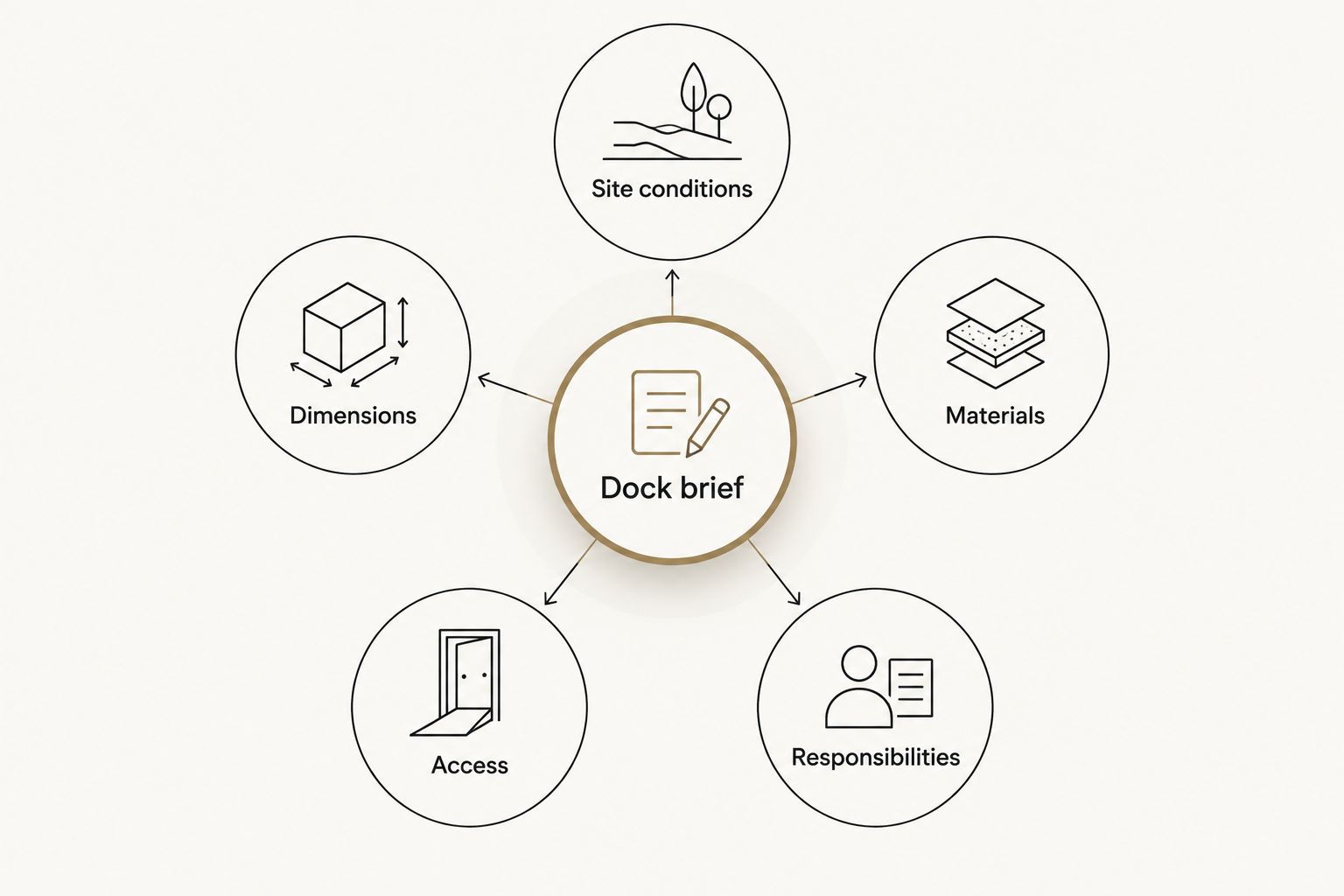
Organize the brief around these points:
- Site conditions: State the location, water type, observed water-level changes and whether the proposal concerns a new platform or existing structure.
- Dimensions: Record the intended platform length and width, connection points and transitions. Mark approximate measurements clearly rather than presenting them as surveyed dimensions.
- Materials: Name your preferred walking surface and acceptable alternatives. Include any requirement to retain existing components.
- Access: Provide at least 3 site photos: the waterfront edge, the proposed platform area and the approach from the unloading location.
- Responsibilities: Name 1 project contact for decisions. Identify who coordinates drawings, approvals, demolition, transport, installation and any separately required qualified work.
Measure 2 access widths where relevant: the narrowest gate opening and the narrowest passage to the waterfront. Include the proposed completion date, explain whether it is fixed, and ask which site details need verification before a commitment.
Ask for the proposal to distinguish retained components from new work. A new surface should not conceal unanswered questions about the framing beneath it, and a material recommendation should not imply engineering or approval responsibilities that have not been agreed.
Which dock material should you choose?
Choose appropriately treated lumber if you want a natural wood platform and accept ongoing care. Choose capped composite for reduced refinishing, cellular PVC for a wood-free board, aluminum for modular construction, or grating for a specifically required open surface.
Before approving a 2026 specification, request the exact material designation, intended exposure, fastening approach and maintenance instructions. Select the complete assembly, not just the board that looks best in a sample.
FAQ
What's the best material for a Florida dock?
Appropriately treated lumber is a practical default for a Florida dock when you accept wood care and want individually replaceable boards. Composite, PVC, aluminum and grating suit different surface or construction priorities; the exact product must match the exposure.
Is composite better than wood for a waterfront platform?
Composite is better suited to reducing routine surface refinishing, while wood suits owners who prioritize a natural surface and cut-to-fit repairs. Compare the exact composite board's waterfront permissions, support requirements and maintenance instructions before choosing.
Can I use ordinary treated lumber in saltwater?
Do not assume a generic treated-lumber designation establishes saltwater suitability. Specify treatment for each component's actual exposure, including immersion where applicable, and check compatible fasteners and connectors.
Does PVC decking replace dock framing?
PVC deck boards do not automatically replace structural dock framing. Use each product only for its documented role and confirm the supporting assembly separately.
Will composite or PVC stay cool in Florida sun?
Neither composite nor PVC guarantees a cool barefoot surface. Review the specific board, color and exposure, and inspect samples under conditions that resemble the proposed site.
What should I send when requesting a dock quote?
Send the location, water exposure, platform dimensions, site photos, preferred materials and access information. Include your deadline and identify who handles drawings, approvals, transport, installation and other required work.
Does JB Woodworks LLC build waterfront platforms near Orlando?
JB Woodworks LLC builds custom docks, waterfront platforms and walkways for residential and project-team clients. Discuss the location, scope, materials and installation logistics before commitments, especially for work beyond nearby Central Florida communities.
One last thing
Ask how a damaged board or panel will be removed after the dock is finished. If replacement requires dismantling an edge, railing or adjoining section, that detail belongs in the material decision now—not in a future repair conversation.