Best overall: white oak. Best for a dark, expressive tabletop: black walnut. Best for a pale, hard-wearing surface: hard maple. The best wood species for a custom dining table depends on how you use the table, the grain you want, and the finish you will maintain. This 2026 guide compares those choices with black cherry and white ash, then explains what to include in a useful commission brief.
- White oak is the best wood species for a custom dining table when everyday use and visible grain matter.
- Black walnut suits darker custom furniture; hard maple suits pale dining tables with greater dent resistance.
- Black cherry brings warmer color; white ash offers a light surface with pronounced grain.
- JB Woodworks LLC builds custom tables; discuss dimensions, materials, finish, access, and installation before committing.
Why this matters
A dining table is a working surface, not just a wood sample. You eat at it, pull chairs against it, wipe spills from it, and see it under changing light. Choose the species around those conditions before deciding on a stain color.
For an Orlando commission, JB Woodworks LLC builds made-to-order custom tables. Bring reference photographs and room measurements to the conversation, but separate the appearance you like from the construction decisions that make the table fit your space.
White oak is the best default dining-table species for households that want visible grain and good resistance to everyday dents. It is not the right answer for every room: a darker interior, a preference for quiet grain, or a desire for warmer color points elsewhere.
What makes the best wood for a dining table?
Judge your 2026 shortlist against these criteria before comparing names:
- Dent resistance: Consider dropped utensils, chair contact, homework, and other everyday use. Hardness helps, but it does not make a surface damage-proof.
- Grain character: Decide whether you want strong lines, fine texture, or a quieter background for place settings.
- Natural color: Start with the wood's own appearance rather than assuming stain will make every species look alike.
- Finish compatibility: Review the intended sheen, color treatment, care requirements, and repair approach together.
- Construction and movement: Solid wood responds to moisture changes. The tabletop and base connection must accommodate that movement.
- Room fit: Evaluate the wood beside your flooring, cabinetry, chairs, and actual dining-room lighting.
Dining-table woods at a glance
These are species recommendations, not a statement that particular boards or finished tables are offered for a project. Review the proposed material during quoting.
| Wood species | Best for | Standout characteristic | Key limitation |
|---|---|---|---|
| White oak | An everyday table with visible grain | Pronounced grain and good dent resistance | Open texture is not a smooth-looking grain pattern |
| Black walnut | A naturally dark statement table | Brown tones and expressive grain | Softer than white oak, hard maple, and white ash |
| Hard maple | A pale, hard-wearing tabletop | Fine texture and high dent resistance | Stain needs careful sample approval |
| Black cherry | A warm table that changes with age | Fine texture and color that deepens with light exposure | Softer than the other shortlisted species |
| White ash | A light table with strong grain | Pale tones and prominent grain lines | Grain remains visually assertive |
1. White oak: best dining-table wood for everyday use
White oak combines visible grain with useful resistance to dents. Its natural appearance works well when you want the tabletop to read clearly as wood rather than as a uniformly colored surface.
Board selection matters. Quarter-sawn white oak can show prominent ray fleck, while other cuts produce a different grain pattern; ask to see the intended character rather than approving the species name alone. A finish sample should show both the color and the texture you expect across the table.
White oak pros:
- Good dent resistance for an everyday dining surface.
- Distinct grain that gives a simple table visual interest.
- Different sawing patterns offer different appearances within the species.
White oak cons:
- Open pores remain part of its visual character unless the finishing process addresses them.
- Strong grain or ray fleck does not suit every preference for a quiet surface.
Best for: Households seeking an everyday dining table with visible grain.
Verdict: Buy if you like oak's grain in a finished sample, not merely in a reference photograph.
2. Black walnut: best dining-table wood for natural dark color
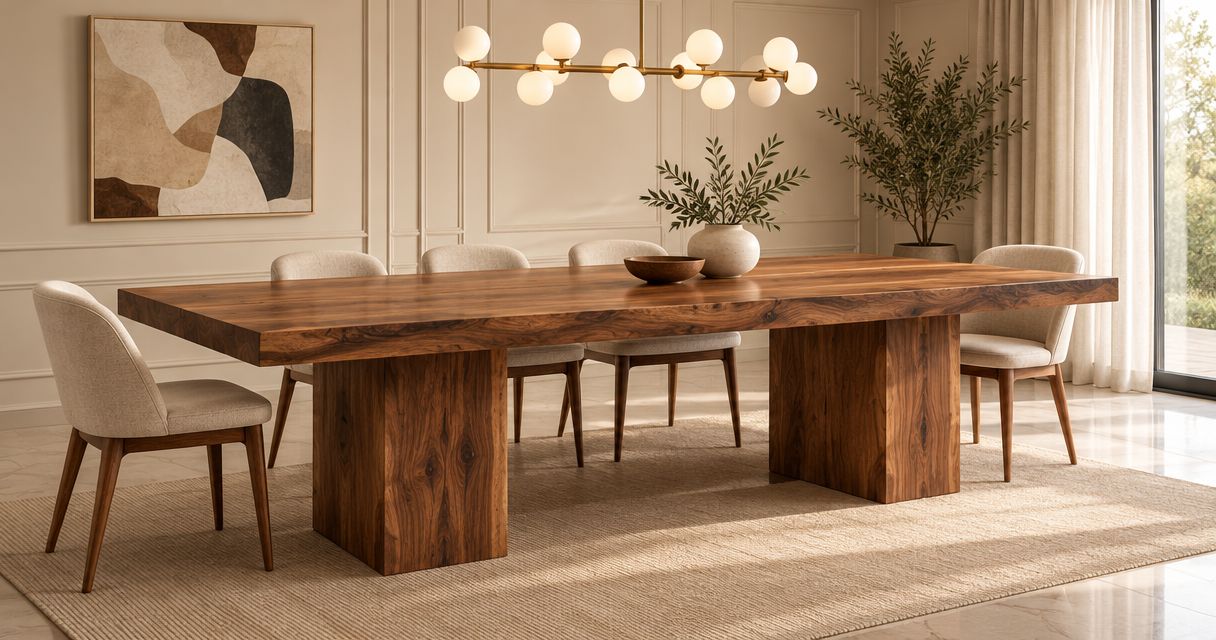
Black walnut suits a dining room where the tabletop should provide darker color without relying entirely on stain. Its heartwood has brown tones, while sapwood is lighter; the balance between them changes the finished appearance.
Specify whether you welcome that contrast. A request for an expressive walnut top and a request for consistent dark color are different briefs, even when both use the same species.
Black walnut pros:
- Naturally dark heartwood provides a clear alternative to pale woods.
- Grain variation gives a restrained table shape visual interest.
- Heartwood and sapwood contrast can become an intentional design detail.
Black walnut cons:
- Lower dent resistance than white oak, hard maple, or white ash.
- Natural color variation needs board-selection agreement if you want consistency.
Best for: Buyers who prioritize a naturally dark tabletop and accept visible signs of use.
Do not choose walnut expecting its color to stay identical indefinitely. Wood appearance changes with light and age, so assess it as a living material rather than a fixed paint color.
Verdict: Buy for natural dark character; skip if dent resistance is your leading criterion.
3. Hard maple: best dining-table wood for a pale, durable surface
Hard maple offers a fine texture and strong resistance to indentation. Here, hard maple means sugar maple, not every wood sold under the broader maple name.
Choose it when you want the surface to feel visually quieter than oak or ash. If your design depends on a dark stain, approve a representative finished sample first: maple can absorb color unevenly, and a small color chip does not show the whole result.
Hard maple pros:
- The highest Janka hardness among the species in this shortlist.
- Fine texture suits simple, restrained furniture forms.
- Naturally pale material offers an alternative to darker walnut.
Hard maple cons:
- Uneven stain absorption requires attention during finish selection.
- A pale, relatively quiet surface is not a substitute for oak's pronounced grain.
Best for: Busy households wanting a light tabletop with high dent resistance.
Hardness does not remove the need for placemats, sensible cleaning, and a suitable finish. A hard wood can still be scratched or marked, and the finish has its own care requirements.
Verdict: Buy for a pale everyday table; hold if the design depends on an unapproved stained finish.
4. Black cherry: best dining-table wood for warmth and aging
Black cherry has a fine texture and a warm appearance that deepens with light exposure. Choose it because you welcome that change, not because you expect the delivery-day color to remain fixed.
Compare cherry samples with that aging behavior in mind. An older reference table and a freshly finished sample do not represent the same point in the material's life.
Black cherry pros:
- Fine texture works well with understated furniture details.
- Warm color provides an alternative to pale maple and dark walnut.
- Natural aging becomes part of the table's character.
Black cherry cons:
- The lowest Janka hardness in this shortlist means greater susceptibility to dents.
- Uneven light exposure can produce uneven color development.
Best for: Buyers who value warm color and accept both aging and everyday marks.
Avoid treating cherry as a way to obtain a permanently uniform reddish surface. Discuss the intended finish, the room's light, and how regularly covered areas will be exposed.
Verdict: Buy if aging is part of the appeal; skip if fixed color and maximum dent resistance matter most.
5. White ash: best dining-table wood for light color and bold grain
White ash combines a generally pale appearance with prominent grain. It belongs on your shortlist when maple feels too quiet but you do not want walnut's darker tones.
Judge ash across a representative group of boards, not one narrow sample. Strong grain becomes a major feature across a full dining tabletop and should complement, rather than compete with, nearby flooring and cabinetry.
White ash pros:
- Good dent resistance for regular dining use.
- Pale tones support a lighter-looking table.
- Pronounced grain gives straightforward shapes visible character.
White ash cons:
- Open grain does not produce the same visual smoothness as maple or cherry.
- Strong grain can compete with other patterned wood surfaces in the room.
Best for: Buyers seeking a pale dining table with a clear, visible grain pattern.
Ask for the proposed finish on ash itself. A finish shown on oak or maple does not establish how the same treatment will look on ash.
Verdict: Buy for pale color and bold grain; skip if you want the tabletop to recede visually.
How the woods rank on dent resistance
For this 2026 comparison, the USDA Forest Products Laboratory's Wood Handbook provides useful reference values for these species. Commonly published Janka hardness values are 1,450 pounds-force for sugar maple, 1,360 pounds-force for white oak, 1,320 pounds-force for white ash, 1,010 pounds-force for black walnut, and 950 pounds-force for black cherry.
Janka hardness measures resistance to indentation. It does not measure water resistance, finish performance, joint strength, or the quality of a completed table.
The ranking above therefore uses hardness alongside grain, natural color, and the compromises each buyer must accept. It is a selection guide, not a claim that one species makes every table better.
Which wood should you choose in 2026?
Choose white oak if you are undecided. It offers a practical middle ground: good dent resistance, visible grain, and a clear reason to choose solid wood.
Choose black walnut when dark natural color leads the brief. Choose hard maple when a pale surface and dent resistance matter more than pronounced grain. Choose black cherry for warmth and aging, or white ash for light color with stronger grain lines.
JB Woodworks LLC is a custom dining-table option for Orlando homeowners and project teams seeking a table made for the space. The useful next step is a discussion of dimensions, materials, finish, and installation—not a species decision made in isolation.
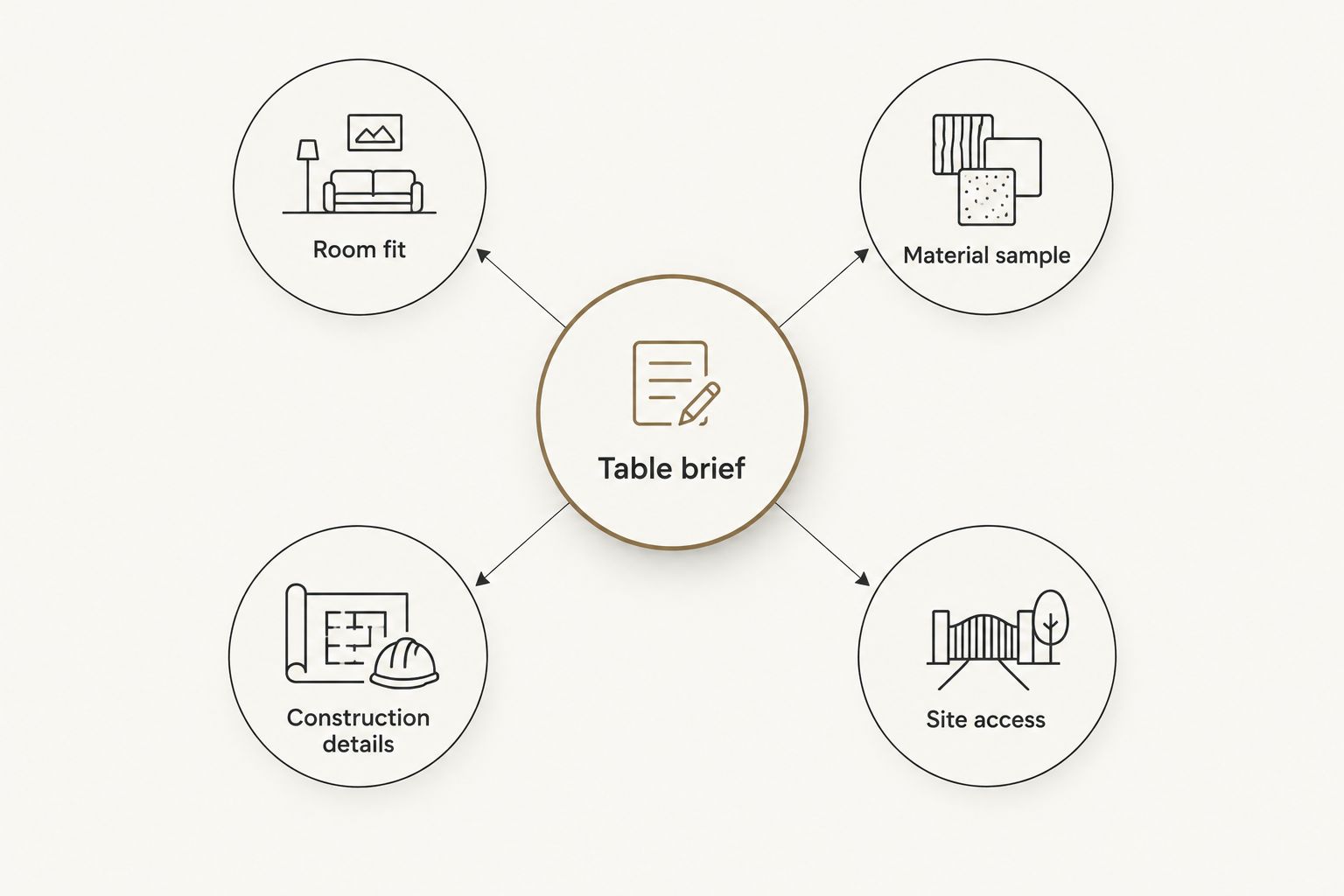
Prepare a useful custom-table brief
For a 2026 quote request, turn your preferences into a brief that distinguishes requirements from open questions. You do not need production drawings to explain how the table must work.
Room fit
Provide the intended table length, width, and height in inches, plus room measurements and photographs. Include chair dimensions where possible, particularly arm height and how far chairs must tuck beneath the tabletop.
Mark nearby doors, circulation routes, and other furniture. Seating count alone does not tell a maker how the table fits or whether the base will interfere with knees and chairs.
Material sample
Name your preferred species and one acceptable alternative. Describe whether you want quiet grain, strong grain, consistent color, or visible natural variation.
Review the proposed finish on the intended wood under your room's lighting. Ask what the sample establishes about color, sheen, texture, and variation—and what still needs approval.
Construction details
Include reference photographs, sketches, or existing drawings, and explain which details matter. Separate the overall silhouette from specific requests for the tabletop edge, base shape, overhang, and leg placement.
Ask how the design accommodates solid-wood movement. If the table sits near glazing or an air-conditioning outlet, include that information rather than assuming the site conditions are irrelevant.
Site access
Describe stairs, doorways, elevators, parking, and the route into the dining area. Explain whether the project requires coordination with a contractor, designer, or building manager.
State your requested deadline and who handles transport, assembly, placement, and any related work. For projects beyond Orlando and nearby Central Florida communities, scope, travel, and installation logistics need review before commitments.
FAQ
What's the best wood species for a custom dining table?
White oak is the best default for an everyday custom dining table when you want visible grain and good dent resistance. Choose hard maple for a paler, finer-textured surface or black walnut for naturally darker color.
Is walnut better than oak for a dining table?
Black walnut is better for a naturally dark appearance; white oak is better for dent resistance. The right choice depends on whether color or resistance to everyday indentation matters more to you.
What's the hardest wood in this dining-table shortlist?
Hard maple, specifically sugar maple, has the highest Janka hardness in this shortlist at 1,450 pounds-force. That measures indentation resistance, not protection against every scratch, spill, or finish mark.
Will a cherry dining table change color?
Black cherry deepens in color with light exposure. Review that aging behavior before approving the wood, especially if parts of the tabletop will remain covered.
Should I choose the wood or the stain first?
Choose the wood and intended appearance together, then approve a finish sample on that species. The same color treatment does not produce an identical result across maple, oak, walnut, cherry, and ash.
How much does a custom dining table cost?
A useful quote requires dimensions, species, base design, finish, and delivery or installation scope. Send those details together so the proposed work is clear before you compare quotes.
What should I send JB Woodworks LLC for a custom dining table?
Send room and table dimensions, photographs, preferred wood, finish references, seating needs, and site-access details. Include your requested deadline and identify who coordinates transport, assembly, and placement.
One last thing
Before you approve a wood sample in 2026, put it beside your actual floor and chairs—not just a white wall. A species you like on its own can compete with the strongest wood pattern already in the room. Approve the combination, not the sample in isolation.