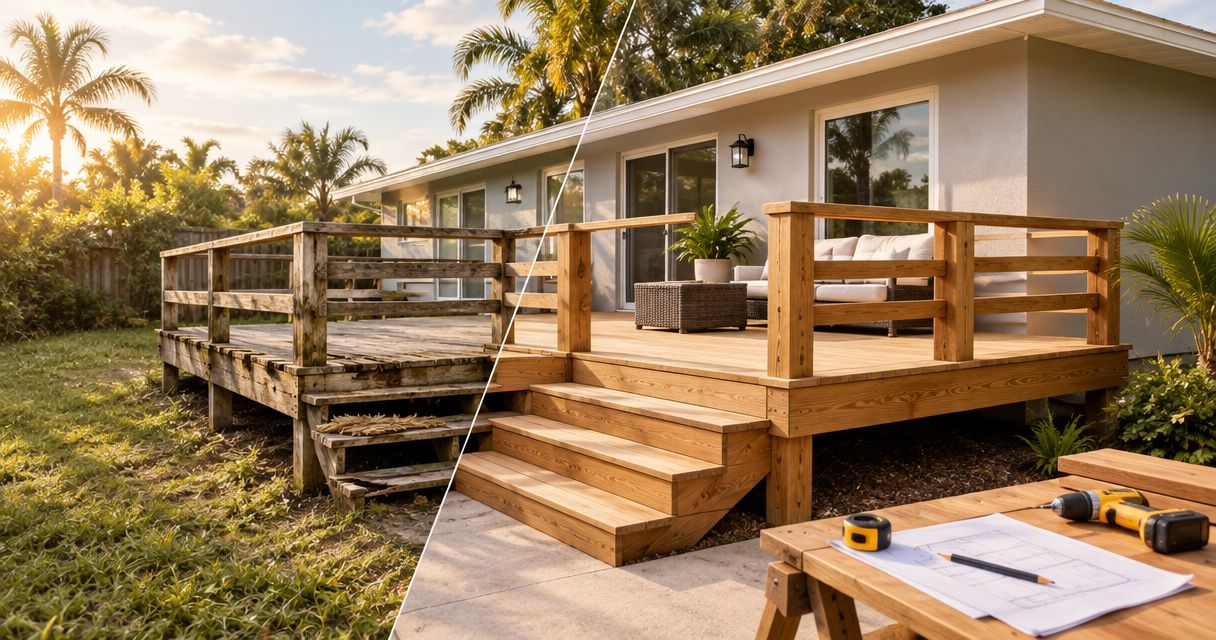
An Orlando deck can be repaired when damage is limited and the supporting structure remains suitable to keep; replacement is the stronger choice when deterioration affects the frame, supports, or critical connections throughout the deck. New surface boards do not resolve damaged framing underneath. Before choosing a scope in 2026, have the existing structure assessed and separate cosmetic work from work needed for safe use.
- JB Woodworks LLC offers custom deck carpentry for Orlando homeowners planning work around an existing space.
- For the search deck builders orlando, compare inspection findings and written scopes rather than surface appearance alone.
- Deck repair suits isolated damage only when the surrounding structure remains suitable to retain.
- Deck replacement addresses widespread deterioration; resurfacing alone does not repair compromised framing.
Why this matters
A deck can look worn without needing complete replacement. It can also look presentable while connections or concealed framing need attention. The decision starts underneath the walking surface, not with the finish color.
JB Woodworks LLC provides custom deck carpentry for Orlando homeowners who want work made for the space. A useful project conversation starts with the existing deck, its condition, and how you intend to use it—not an assumption that everything must stay or everything must go.
For a 2026 project, keep repair needs separate from requested improvements. Replacing damaged components and changing the deck's footprint are different decisions, even when you want both included in the same proposal.
Can an Orlando deck be repaired, or does it need replacing?
An Orlando deck is a repair candidate when the damaged components can be replaced without retaining unsuitable supporting material. Replacement becomes the appropriate scope when deterioration is widespread or the structure cannot support the proposed work without substantial reconstruction.
Resurfacing sits between those choices. It replaces the walking surface while retaining suitable underlying framing, so it requires an assessment of what stays.
| Approach | Best for | What the scope addresses | Main limitation |
|---|---|---|---|
| Targeted repair | Isolated damage with suitable surrounding construction | Identified boards, connections, rails, steps, or framing components | Leaves the rest of the existing deck in place; concealed conditions still matter |
| Resurfacing | Worn decking over framing confirmed suitable to retain | Walking-surface replacement and any separately identified supporting work | Does not correct deterioration in framing that remains |
| Replacement | Widespread deterioration or a proposed layout that requires reconstruction | Removal and rebuilding of the agreed deck scope | Requires broader decisions about demolition, access, design, and installation |
Choose the smallest scope that addresses the actual defects—not the smallest scope that makes them less visible. A repair proposal should identify what remains as clearly as it identifies what will be replaced.
A full replacement also needs justification. Ask which conditions make retention unsuitable, rather than accepting age or appearance as the entire explanation.
When targeted deck repair makes sense
Targeted repair makes sense when damage has a defined boundary and the adjacent components remain suitable for continued use. A damaged surface board does not, by itself, establish that the entire deck needs replacement.
The important question is what caused the damage. Replacing a board without addressing a water-trapping detail or a failed connection leaves the cause unresolved. Ask the person assessing the deck to explain both the defect and the proposed correction.
Your written repair scope should identify:
- The components to be removed and replaced.
- The surrounding components intended to remain.
- The connection and material details included in the work.
- Any opening-up needed to inspect concealed areas.
- How additional findings will be documented and approved.
The advantage is a focused intervention that retains suitable construction. The limitation is that retained components remain part of the deck's future maintenance needs. A repaired deck is not automatically equivalent to an entirely new deck.
When resurfacing is a reasonable option
Resurfacing is appropriate when you want to replace worn decking and the supporting frame is suitable for that work. It is a surface-replacement decision supported by a structural assessment, not a substitute for one.
Before choosing replacement boards, confirm the proposed material's installation requirements against the existing support arrangement. Board dimensions, fastening methods, and support requirements must be considered together. A material change is not simply a color selection.
The practical benefit is retaining suitable framing while renewing the walking surface. The constraint is that the new surface still depends on the old structure beneath it.
If resurfacing is part of your 2026 plan, ask for the framing review to happen before finalizing the material scope. Specify whether railings, stairs, trim, and finishing are included or remain separate. That prevents a surface-only proposal from being mistaken for a complete deck renovation.
When replacement is the better scope
Replacement is the better scope when significant deterioration extends through supporting components or when the proposed changes require substantial reconstruction. Multiple connected defects need to be considered together rather than treated as unrelated patches.
A replacement discussion should explain the condition of the existing supports, framing, attachment points, stairs, and guard assemblies. It should also establish whether anything can reasonably remain. The word replacement does not define the demolition boundary on its own.
Replacement offers a chance to reconsider access, circulation, and the deck's relationship to the house or yard. Its limitation is the broader coordination involved: removal, material handling, site access, and installation all become part of the brief.
Before proceeding, ask what permitting, design information, inspections, or qualified trade involvement the proposed scope requires. Do not assume that a carpentry proposal includes engineering or every approval needed for the work. Responsibilities should be confirmed before commitments.
How to assess the deck before choosing a scope
You can prepare useful observations without testing the deck yourself. Do not jump on suspect areas, remove structural fasteners, or crawl beneath an unstable deck. Keep people off an area that moves unexpectedly or has visibly failed components until it has been assessed.
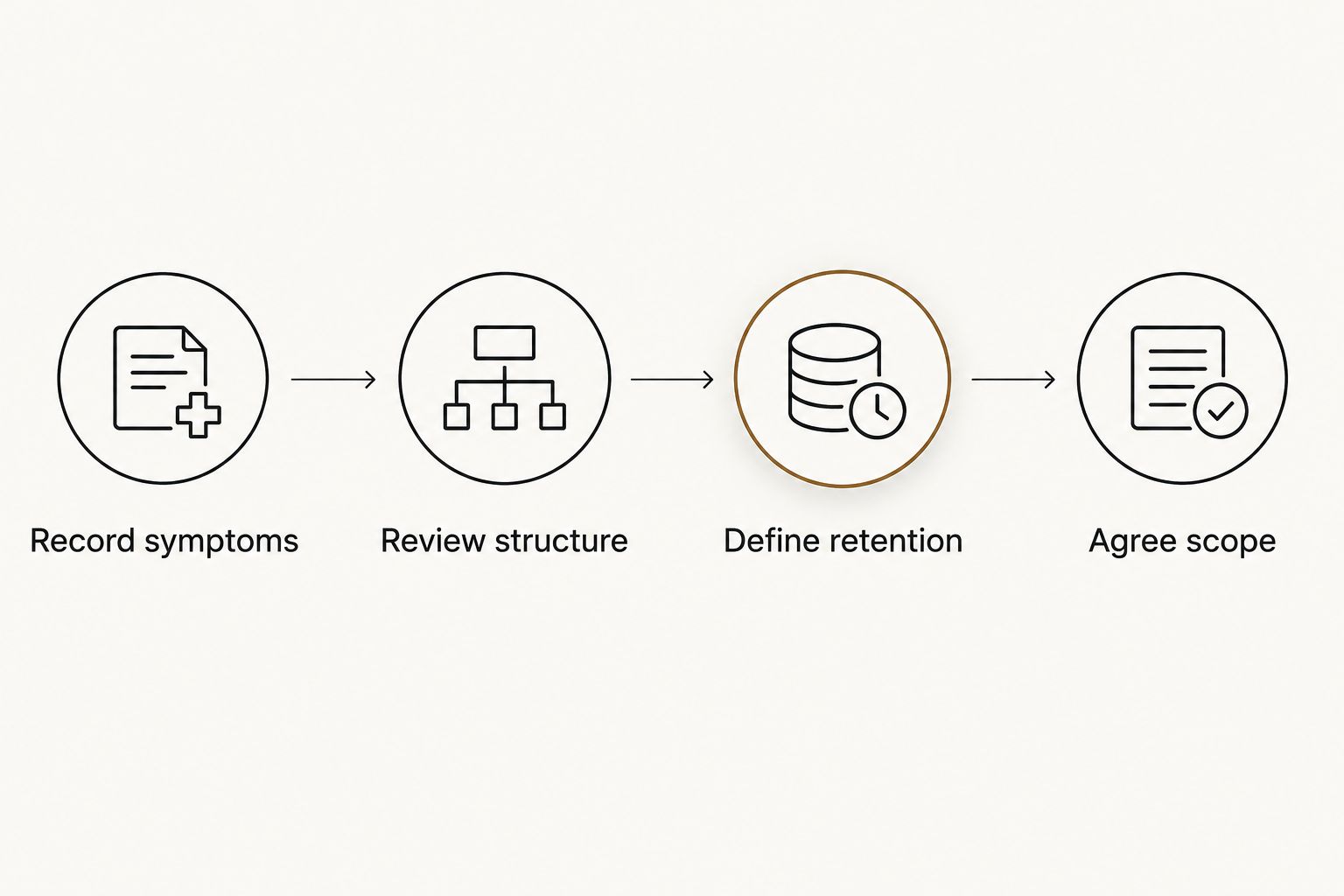
Use this sequence to organize the discussion:
- Record symptoms. Photograph visible damage from safe positions. Note movement, soft areas, loose rails, staining, and places where water collects.
- Review structure. Ask for an assessment of the supports, framing, house attachment where present, stairs, and connections—not only the boards you walk on.
- Define retention. Establish which components are suitable to keep and what further access is needed to reach that conclusion.
- Agree scope. Separate necessary repairs, optional improvements, and any unresolved conditions in writing.
These steps turn a broad question about replacement into a component-by-component decision. They also give you a clearer basis for comparing proposals.
An assessment should distinguish what is visible from what remains concealed. If boards must be lifted to inspect a connection or framing area, establish who authorizes that work and how the findings affect the proposal.
Why the repair-or-replace decision varies
The same visible symptom can lead to different scopes because the condition behind it differs. A loose board and a deteriorated supporting member are not interchangeable problems.
- Extent of damage: An isolated defect supports a different discussion from deterioration spread across connected components.
- Location of damage: Damage at a support or critical attachment requires different attention from surface wear.
- Condition of retained framing: New decking depends on the structure that remains beneath it.
- Water exposure and drainage: The scope should address relevant moisture-trapping conditions rather than only replace affected material.
- Proposed changes: A different footprint, stair position, railing arrangement, or decking material changes what needs review.
- Access and responsibilities: Demolition, material transport, installation access, approvals, and work by other trades affect the project plan.
For Orlando homeowners comparing scopes in 2026, the useful distinction is not old versus new. It is suitable to retain versus needing correction. Ask for that distinction to be made explicitly.
What should you send with a deck quote request?
Send enough information for a carpenter to understand the existing deck and your intended outcome. Clear preparation supports a useful conversation; it does not replace an on-site assessment.
Include an overall photograph showing the deck's relationship to the building and yard. Add close views of visible defects, stairs, railings, and accessible framing, taken without entering unsafe areas. Label where each photograph was taken so the details have context.
Your project brief should cover:
- Dimensions: Approximate deck size, height, and stair arrangement, clearly marked as homeowner measurements where applicable.
- Existing materials: Identify what you know and provide photographs rather than guessing at concealed construction.
- Observed problems: Describe what moves, feels soft, holds water, or has visibly deteriorated.
- Desired outcome: State whether you want repair, a renewed surface, a different layout, or advice on the appropriate scope.
- Site access: Explain gates, narrow routes, landscaping, occupied areas, and other restrictions on moving materials.
- Timing and coordination: Share your preferred project period, other scheduled work, and the person responsible for decisions.
If you are requesting work from JB Woodworks LLC, describe the deck carpentry scope and any related work separately. Do not assume that an adjoining pergola, finish work, or another feature is included because it appears in the same photograph.
How do you compare repair and replacement proposals?
Compare the components and responsibilities, not just the labels at the top of the documents. A repair proposal that includes framing corrections is a different scope from one that only replaces surface boards.
For your 2026 comparison, ask each proposer to identify retained construction, removed construction, proposed materials, and installation responsibilities. Request a clear explanation of exclusions and the process for approving changes after concealed areas are exposed.
Check the finish boundary as well. New boards beside retained boards can differ in appearance, and finishing needs its own defined scope. Ask what preparation and finishing are included rather than treating a uniform appearance as an unstated promise.
Do not choose a replacement proposal simply because it sounds more complete, or a repair proposal simply because it removes less. Choose a documented scope that addresses the findings and clearly assigns the remaining decisions.
Can I replace just the deck boards?
You can replace just the deck boards when the framing, connections, and support arrangement are suitable for the replacement material. Surface wear alone is not a reason to discard sound supporting construction.
The limitation is that removing boards can expose conditions that were not visible during an initial visit. Agree in advance how those discoveries will be photographed, explained, and approved before additional work proceeds.
Does a loose railing mean the whole deck needs replacing?
A loose railing does not, by itself, establish that the whole deck needs replacement. The assessment must determine whether the problem is confined to the railing connection or extends into the supporting material.
Avoid leaning on or using a loose railing while its condition is unresolved. Ask for the proposed correction to identify the connection and the material receiving it, not merely a promise to tighten the rail.
FAQ
How do I know whether my Orlando deck needs repair or replacement?
An Orlando deck needs a condition assessment that separates isolated defects from deterioration affecting the supporting structure. Repair suits limited damage with suitable retained construction; widespread defects can require replacement.
Can new deck boards go over an old frame?
New deck boards can go over an existing frame only when that frame is suitable to retain and meets the replacement material's installation requirements. Review framing and connections before finalizing resurfacing.
Should I keep using a deck that feels unstable?
Do not keep using a deck or affected area that feels unstable or has visibly failed components. Keep people away and arrange an assessment rather than testing its strength yourself.
What should I ask deck builders in Orlando before accepting a repair quote?
Ask deck builders in Orlando which components will remain, which will be replaced, and what supports that decision. Confirm exclusions, concealed-condition procedures, materials, and installation responsibilities in writing.
Does deck replacement include permits and engineering?
Do not assume deck replacement includes permits, engineering, or every required approval. Confirm the requirements for the specific scope and identify who is responsible before committing.
What should I send JB Woodworks LLC about a deck project?
Send JB Woodworks LLC photographs, approximate dimensions, observed defects, your intended outcome, and site-access information. Identify any related carpentry separately so the requested scope is clear.
Is resurfacing the same as repairing the deck structure?
Resurfacing is not the same as repairing the deck structure. It replaces the walking surface; any necessary framing, connection, stair, or railing corrections need an explicit scope.
One last thing
Ask for a written description of what stays, not only what gets replaced. Retained components are the foundation of a repair or resurfacing decision, yet a removal list alone does not explain their condition.
That single request makes a proposal easier to understand. It directs the conversation toward the existing deck, the evidence available, and the work needed for your space.