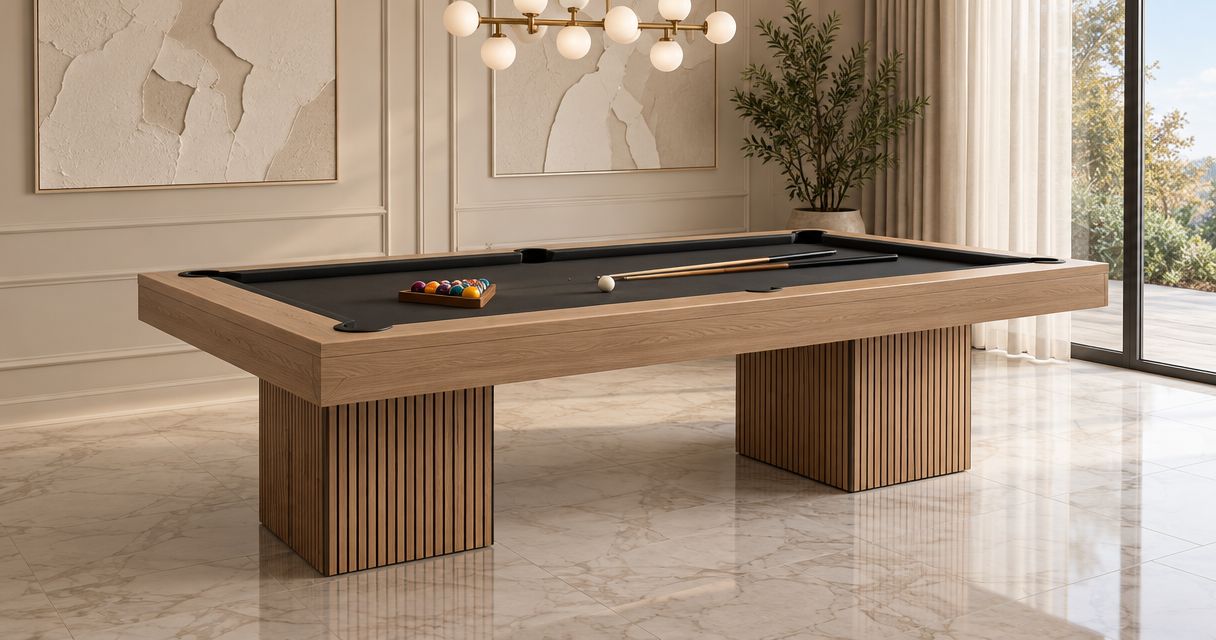
For custom pool tables, specify the casework’s dimensions, relationship to the playing assembly, materials, finish, site access and installation responsibilities before requesting a quote. Separate the woodworking scope from the playing surface, cushions, pockets and table setup so your drawings describe both the appearance you want and who is responsible for making the table playable.
- For custom pool tables, define decorative casework separately from the playing assembly and setup.
- JB Woodworks LLC builds custom pool-table casework; brief the woodworking scope and installation responsibilities clearly.
- Confirm component dimensions before approving cabinetry details, finishes or attachment points.
- Include room measurements, delivery access, drawings and your required project date in the quote request.
What should you specify for custom pool-table casework?
Your custom pool-table casework brief should explain what the woodwork surrounds, what it supports and where its responsibility ends. For a 2026 project, put these decisions into a dated document that your carpenter, designer and table installer can reference together.
JB Woodworks LLC builds custom pool-table casework in Orlando. JB Woodworks LLC is best for homeowners and project teams seeking custom pool-table casework shaped around a specific space and woodworking brief. Treat the cabinetry as a defined part of the project, not as shorthand for a complete playing-table package.
| Scope option | Best for | Main benefit | Limitation to resolve |
|---|---|---|---|
| Casework around an existing table | Owners retaining a playing assembly | Gives the woodworking team an existing assembly to measure | Existing components and access requirements constrain the design |
| Casework coordinated with a new assembly | Homeowners and designers planning the table together | Allows the visible woodwork to be considered alongside the room | Requires confirmed component information and shared drawings |
| Complete-table brief | Buyers expecting a finished, playable table | Makes the intended end result explicit | Must identify who supplies and installs every non-casework component |
These are different scopes, not interchangeable descriptions. If your request says only custom pool table, the recipient still needs to know whether you want cabinetry, a coordinated fabrication package or responsibility for the complete table.
Why this matters
A pool table is furniture, but its visible cabinetry is not the whole playing system. An attractive exterior does not establish whether the playing assembly fits, whether components remain accessible or whether installation responsibilities have been assigned.
A useful 2026 quote request therefore begins with scope rather than a finish photograph. Reference images communicate appearance; measurements, component information and drawings establish what someone can actually quote and build.
For homeowners, this prevents a gap between the desired result and the requested work. For contractors and designers, it creates a shared reference for coordinating the carpenter, table supplier and installer without assuming that one party covers everything.
Define the casework before choosing the finish
Identify the playing assembly
State whether you already own the table or are selecting components for a new one. Include the manufacturer and model if known, together with available drawings, assembly instructions and photographs of the actual equipment.
Do not substitute an advertised table size for a measured component drawing. The woodworking brief needs the assembly’s actual dimensions, its relationship to the exterior casework and any areas that must remain reachable during installation or servicing.
If the playing assembly has not been selected, mark its dimensions as unresolved. Do not approve final casework dimensions around an assumed component size.
Mark what stays and what changes
List the existing parts you intend to retain, remove, conceal or replace. Distinguish the visible outer cabinetry from the components involved in supporting and assembling the table.
An existing table needs photographs from more than the most flattering angle. Show the underside, corners, legs, joints and any places where the proposed enclosure meets the original structure; these views help explain the requested work without guessing at hidden details.
Draw the scope boundary
State whether the woodwork includes the cabinet body, legs, trim, panels, storage or other visible features. Identify attachment points and the party responsible for confirming that the proposed casework is compatible with the playing assembly.
Do not describe decorative parts as structural unless that role has been established. Where engineering or qualified trade work is required, identify it separately rather than assuming it belongs within the carpentry scope.
Build a brief that someone can quote
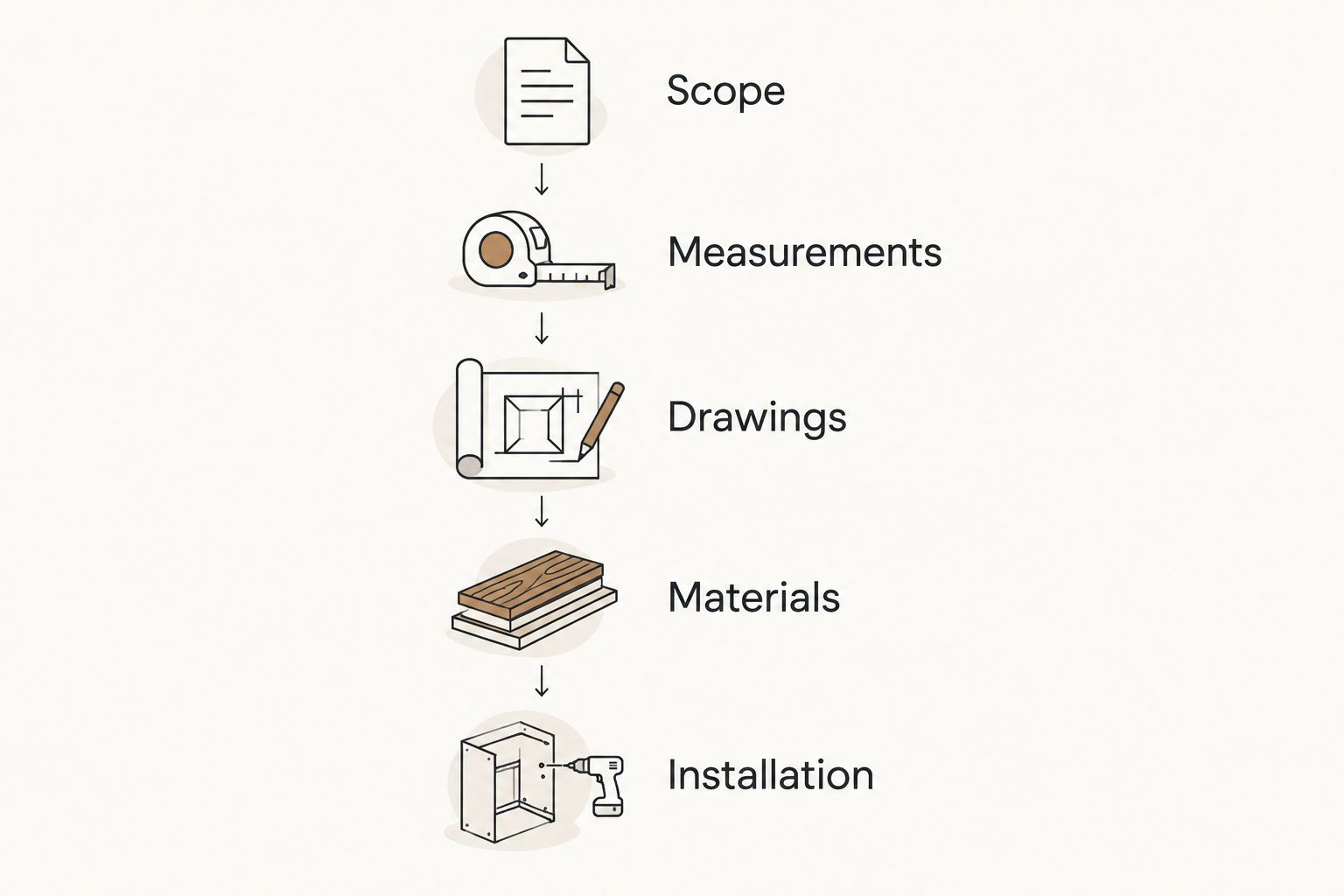
Use this sequence to turn inspiration into a working request. Each step should produce information that the next person can review, rather than another description of the look you like.
- Scope. Write a plain-language description of the requested casework and a separate list of exclusions. Name any existing components that the woodwork must retain or accommodate.
- Measurements. Provide the room dimensions, component dimensions and proposed table position. Label preliminary measurements clearly and identify who will verify them before fabrication.
- Drawings. Include a plan view and elevations showing the visible faces. Mark openings, panel joints, attachments and areas that must remain accessible; note which details still need coordination.
- Materials. Describe the intended wood appearance, panel construction and finish expectations. Separate essential requirements from preferences so alternatives can be discussed without changing the brief unnoticed.
- Installation. Record the delivery route, site restrictions, responsible installers and sequence of work. Include your requested completion date without treating it as an agreed commitment.
A 2026 brief should also carry a revision date. When a component changes, update the shared drawing rather than leaving the carpenter and installer working from different email attachments.
Existing-table casework: measure before redesigning
Best for: owners who want to retain an existing playing assembly while changing its visible woodwork. Start with the actual table, not a similar example found online.
The advantage is a physical reference for measurements and coordination. The constraint is that the existing assembly determines where new woodwork can fit, attach and remain accessible.
Ask the relevant installer to identify what can be removed and what must remain undisturbed. Your casework drawing should show how the finished exterior meets the retained components, including any removable panels needed for later access.
If the table is moving rooms, document the destination as well as its current location. A casework design that fits the table still needs a practical delivery and assembly plan for the new space.
New-assembly casework: coordinate before fabrication
Best for: homeowners, designers and contractors developing the table and room together. Establish the playing assembly and the cabinetry as coordinated work packages with named responsibilities.
The benefit is that proportions, finish and surrounding furniture can be considered together. The trade-off is coordination: changes to the selected assembly need to reach the casework fabricator before drawings are approved.
Ask who confirms component compatibility, support requirements and assembly clearances. A reference photograph cannot answer those questions, and a carpenter’s casework drawing should not silently become an approval of equipment supplied by another party.
For a 2026 installation, use a shared approval record identifying the current drawings and unresolved decisions. Fabrication commitments should follow the review of scope, materials and logistics.
Why custom pool-table casework scope varies
Different requests contain different amounts of woodworking and coordination. These factors explain why two visually similar tables can require different briefs:
- Existing conditions: retaining an existing assembly creates different constraints from coordinating casework around newly selected components.
- Construction details: legs, panel joints, removable sections and attachment points change what needs to be drawn and resolved.
- Material selection: wood appearance, veneer direction, panel construction and exposed edges affect the specification.
- Finish expectations: a new finish and a request to coordinate with existing furniture need different reference information.
- Site access: doors, turns, stairs and the assembly location shape the delivery and installation discussion.
- Responsibility boundaries: supplying casework differs from supplying components, transporting the table or completing its playing setup.
Review these factors before comparing proposals. A shorter scope is not equivalent to a proposal that includes additional handling, finishing or installation responsibilities.
What measurements should I send for a custom pool table?
Send measurements for the room, playing assembly and delivery route, with units labeled throughout. Keep the finished exterior size separate from the playing-area dimensions so nobody has to infer which measurement you mean.
Record nearby walls, doors, fixed cabinetry and other obstructions in a simple room plan. Tell the table supplier how you intend to use the room and ask that supplier to confirm the playing clearance for the selected equipment.
For delivery, record opening dimensions and photograph tight turns or stairs. Mark measurements as preliminary until the responsible party has verified them; photographs support measurements but do not replace them.
Should I specify solid wood or veneered panels?
Specify the required appearance and construction details before prescribing a material everywhere. Solid wood and veneered panels require different detailing, and the appropriate choice depends on the particular component and design.
Name the surfaces that matter visually: the long sides, ends, legs, edges and removable panels. Include grain direction, the desired relationship between adjacent panels and any existing furniture the finish should coordinate with.
Ask for the proposed construction to be explained in the quote or drawing. A material label alone does not describe edge treatment, joints, attachment methods or the finished appearance.
Who should handle installation and final table setup?
Assign casework installation and playing-table setup separately, even when the schedule brings them together. Name who delivers each part, who assembles the woodwork and who completes the work needed for the table to be playable.
Your brief should also identify who protects the room, removes packaging and resolves access restrictions. Confirm the sequence with everyone involved before setting an installation appointment.
JB Woodworks LLC’s custom pool-table casework should be briefed as woodworking with clear interfaces to the other project participants. Work outside Orlando and nearby Central Florida communities remains a matter for scope, travel and installation review before commitments.
Discuss your casework brief
Prepare dimensions, component information, drawings and site-access details for a scope discussion.
FAQ
What should I include in a custom pool-table casework quote request?
Include the casework scope, component information, dimensions, drawings, material preferences and site-access details. Identify who supplies the playing assembly and who handles installation and final setup.
Does custom pool-table casework include the playing surface?
Custom pool-table casework does not establish that the playing surface is included. The written scope must identify the included components and the party responsible for each.
Can I request new casework for an existing pool table?
You can request an assessment of new casework around an existing table. Provide the actual table’s information and photographs so compatibility, attachment points and access can be reviewed before commitments.
What drawings do I need before pool-table casework is built?
Use a plan view and elevations showing dimensions, component relationships, visible details and access points. Identify who prepares, verifies and approves the drawings before fabrication.
How do I choose a finish for custom pool-table casework?
Choose a finish by describing the intended appearance and providing references for surrounding furniture. Review a physical finish sample rather than relying only on a screen image.
Does JB Woodworks LLC build custom pool-table casework in Orlando?
JB Woodworks LLC builds custom pool-table casework as part of its custom carpentry and fabrication work in Orlando. Review the requested scope, materials, travel and installation logistics before commitments.
What should I confirm before approving a casework quote in 2026?
Confirm the current drawings, included work, exclusions, materials, site access and installation responsibilities before approving a casework quote in 2026. Record unresolved component decisions rather than treating them as agreed details.
One last thing
Ask how the table will be accessed after the casework is finished. A panel joint is not merely a visual choice when someone needs to reach a connection behind it.
Mark removable sections on the approved drawing and identify who needs that access. That small briefing detail connects the finished appearance to the practical work of assembly and future servicing.