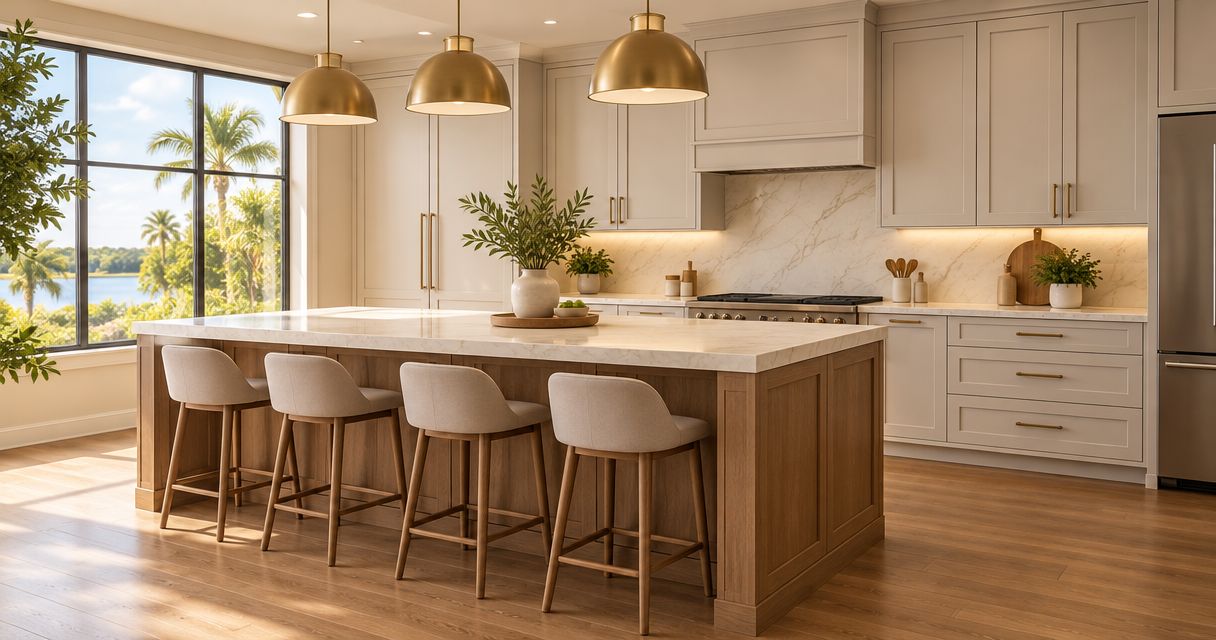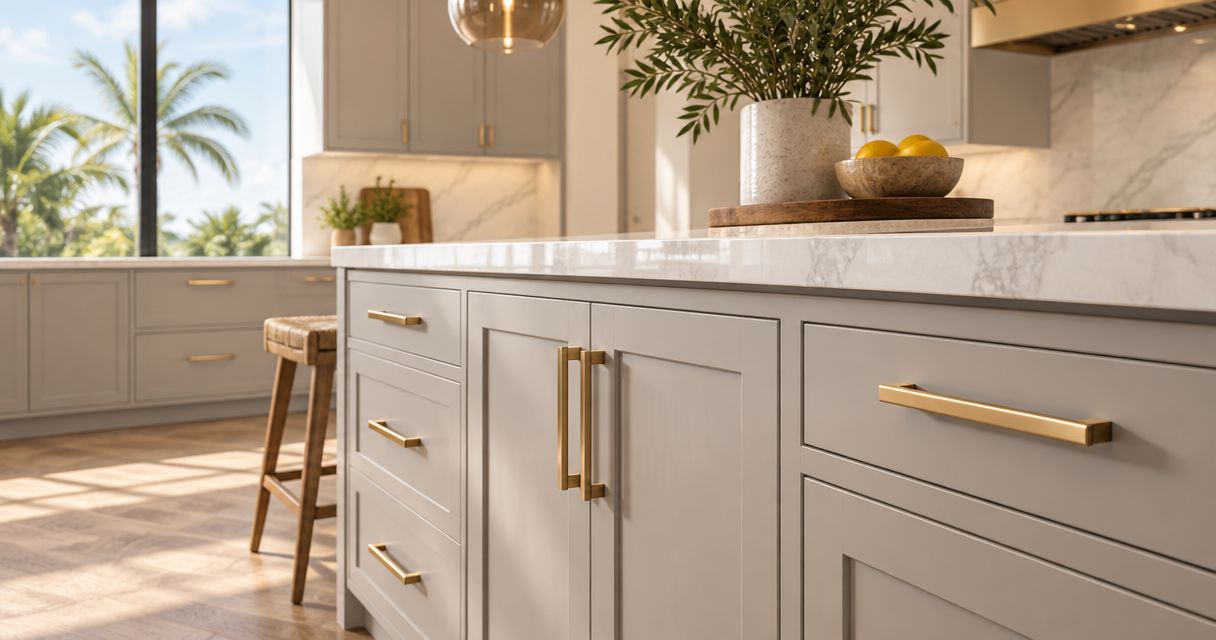
Best overall: simple bar pulls. Best for traditional kitchens: cup pulls. Best for a restrained cabinet update: round knobs. This 2026 guide compares cabinet hardware styles for Orlando kitchens by grip, cabinet design, cleaning, and installation fit.
- Best cabinet hardware styles Orlando: simple bar pulls are the default recommendation for straightforward grip and flexible placement.
- Cup pulls suit traditional drawer fronts; round knobs keep smaller cabinet doors visually quiet.
- Choose hardware by hole spacing, projection, and hand clearance before choosing the finish.
- JB Woodworks LLC builds custom cabinetry for Orlando homeowners; include hardware decisions in the cabinet brief.
Why this matters
Cabinet hardware is both a design detail and something you touch throughout the day. A handle that looks right in a photograph can feel cramped beneath a counter or collide with an adjacent drawer.
For your 2026 kitchen project, separate the hardware's shape from its finish. A bar pull describes the form; brushed nickel, brass, and black describe appearance, not the underlying material or coating specification.
JB Woodworks LLC is best for Orlando homeowners seeking custom cabinetry made for their space. Review the studio's carpentry and fabrication services when defining the cabinet work, then make hardware selection part of that conversation rather than a late installation decision.
What makes the best cabinet hardware style?
Use these criteria before comparing decorative details:
- Grip: Check whether you can grasp the hardware comfortably without pinching or scraping your fingers.
- Cabinet fit: Match the hardware's scale to the drawer front, door frame, and available mounting area.
- Hole compatibility: On existing cabinets, compare the mounting pattern with the holes already drilled.
- Clearance: Check the pull's projection against nearby doors, appliances, walls, and corner cabinets.
- Cleaning: Look at recesses, exposed ends, and textured surfaces where residue collects.
- Visual consistency: Repeat a deliberate shape language without forcing identical hardware onto every cabinet.
A useful selection sequence is shape first, dimensions second, finish third. That order keeps an attractive finish from distracting you from an uncomfortable handle or an unsuitable mounting pattern.
Cabinet hardware styles at a glance
| Hardware style | Best for | Standout feature | Key limitation |
|---|---|---|---|
| Simple bar pulls | Everyday mixed-use kitchens | Full-hand grip with a clear linear shape | Exposed ends can catch clothing |
| Cup pulls | Traditional drawer banks | Recessed grip beneath a curved shell | Less flexible for cabinet doors |
| Round knobs | Smaller cabinet doors | Compact shape with a single mounting point | Requires a smaller gripping motion |
| Arched pulls | Transitional cabinetry | Curved profile between mounting feet | Some designs leave limited finger space |
| Edge pulls | Flat-front cabinetry | Grip positioned at the door or drawer edge | Attachment details need early coordination |
| Bail pulls | Furniture-style islands | Swinging handle with decorative mounting points | Moving parts and recesses complicate cleaning |
These recommendations rank hardware forms, not manufacturers. Use the table to narrow the choice, then handle a physical sample before approving the kitchen's hardware schedule.
1. Simple bar pulls: best cabinet hardware for everyday kitchens
Simple bar pulls give you a handle mounted between two attachment points. Their straight profile works across drawer banks, pantry doors, and many framed cabinet fronts without adding a separate decorative motif.
Best for: Kitchens where comfortable everyday use matters more than ornament. Start with a restrained bar shape, then adjust its length and projection to each cabinet rather than choosing the same dimensions everywhere.
Simple bar pull pros:
- Provides room for a fuller hand grip.
- Offers a clear horizontal or vertical alignment.
- Suits a coordinated mix of doors and drawers.
Simple bar pull cons:
- Extended ends can catch pockets or loose clothing.
- Long pulls need careful alignment across neighboring drawers.
For a 2026 cabinet brief, distinguish overall length from mounting-hole spacing. A longer-looking handle does not necessarily use wider mounting centers, and a matching finish does not establish dimensional compatibility.
Verdict: Buy simple bar pulls as the default shortlist option; reject samples with uncomfortable clearance or snag-prone ends.
2. Cup pulls: best cabinet hardware for traditional drawer banks
Cup pulls create a curved shell with a grip underneath. They give drawer fronts a distinct traditional detail, especially when you want the hardware to read as part of a furniture-like cabinet composition.
Best for: Traditional kitchens with clearly defined drawer banks. Pair cup pulls with a compatible door knob or handle rather than assuming the cup shape belongs on every cabinet opening.
Cup pull pros:
- Gives drawers a recognizable traditional profile.
- Keeps the gripping area beneath the hardware face.
- Establishes a consistent detail across repeated drawer fronts.
Cup pull cons:
- Restricts how you approach the grip.
- Requires cleaning underneath the curved shell.
Check the underside with the actual sample. A shallow opening can look generous from the front while giving your fingers little working room, especially below a projecting countertop.
Keep placement consistent within each drawer bank, but review shallow and deep drawers separately. The visual center of a panel is not automatically the most comfortable mounting position.
Verdict: Buy cup pulls for traditional drawers; skip an all-cup layout without checking door usability.
3. Round knobs: best cabinet hardware for smaller doors
Round knobs attach through a single mounting point and keep the hardware footprint compact. They suit cabinet doors where a long pull would dominate the frame or compete with nearby details.
Best for: Smaller doors and kitchens that need a quiet hardware treatment. Round knobs also offer a straightforward replacement route when an existing door already has one appropriately positioned hole.
Round knob pros:
- Keeps narrow door frames visually uncluttered.
- Uses a single mounting point.
- Pairs naturally with drawer pulls of a related finish.
Round knob cons:
- Requires more finger-focused gripping than a spacious pull.
- Small or slippery shapes can be uncomfortable to use.
Judge the neck as carefully as the face. You need space behind the knob for your fingers, not just a pleasing shape viewed straight on.
For frequently used storage, test the knob with the person who will use that cabinet. A hardware decision should account for grip comfort rather than assuming every household member handles a small knob equally well.
Verdict: Buy round knobs for compact door details; skip tiny samples that sacrifice grip for appearance.
4. Arched pulls: best cabinet hardware for transitional cabinetry
Arched pulls curve between their mounting feet instead of forming a straight bar. They bridge simple cabinet fronts and more detailed trim without committing to either a sharply modern or strongly traditional shape.
Best for: Transitional kitchens where curved details need to sit comfortably beside straightforward cabinetry. Compare the arch against the door profile rather than selecting it from a finish sample alone.
Arched pull pros:
- Adds a softer line to repeated cabinet fronts.
- Provides a handle rather than a pinch-style knob grip.
- Coordinates with both framed and simpler door designs.
Arched pull cons:
- Low arches can leave little knuckle clearance.
- Shaped feet and decorative details add cleaning surfaces.
Inspect the entire underside. Some pulls appear deep at the center but narrow sharply near the mounting feet, limiting where your hand fits.
A rounded profile does not guarantee comfort. Hold the sample at its intended orientation and check whether its edges press into your fingers when you pull.
Verdict: Buy arched pulls for a softer cabinet detail after checking usable hand clearance.
5. Edge pulls: best cabinet hardware for flat-front cabinetry
Edge pulls position the gripping surface at the top or side edge of a cabinet front. They reduce visible hardware on the main face, making them a considered option when uninterrupted cabinet surfaces are the priority.
Best for: Flat-front custom cabinetry with hardware attachment planned alongside the door and drawer construction. Edge pulls deserve an early drawing review, not an assumption that they can replace face-mounted handles without changes.
Edge pull pros:
- Leaves most of the cabinet face visually clear.
- Creates a restrained, repeated edge detail.
- Avoids a conventional handle across the front panel.
Edge pull cons:
- Grip depends heavily on the lip's shape and depth.
- Mounting and neighboring clearances need careful coordination.
For a 2026 renovation, confirm how the selected edge pull attaches and whether the cabinet front needs preparation. Also check the relationship between the pull, countertop overhang, and adjacent front.
Do not choose edge pulls solely because they disappear in a photograph. The hardware still needs to work comfortably from your normal standing position.
Verdict: Buy edge pulls for deliberately planned flat-front cabinetry; hold retrofit purchases until attachment is confirmed.
6. Bail pulls: best cabinet hardware for furniture-style islands
Bail pulls use a swinging handle supported by mounting points. They introduce a furniture-like detail that can distinguish an island or freestanding cabinet from the surrounding kitchen.
Best for: A defined accent area rather than a kitchen that needs the same understated handle everywhere. Use the decorative shape intentionally and check its movement against the cabinet face.
Bail pull pros:
- Gives furniture-style cabinetry a distinct detail.
- Offers a movable handle to grasp.
- Establishes an accent without changing the cabinet profile.
Bail pull cons:
- Moving parts create additional cleaning points.
- The swinging handle can contact the cabinet face.
Check how the handle rests and lifts. Its comfortable operating position matters more than its resting appearance.
Verdict: Buy bail pulls for a deliberate furniture-style accent; skip them when easy cleaning and fixed grips take priority.
Confirm dimensions before approving the hardware
For replacement hardware, measure mounting holes from center to center. Common metric pull spacings include 96 mm, 128 mm, and 160 mm; these describe mounting centers, not the handle's overall length. Never select a replacement by appearance alone.
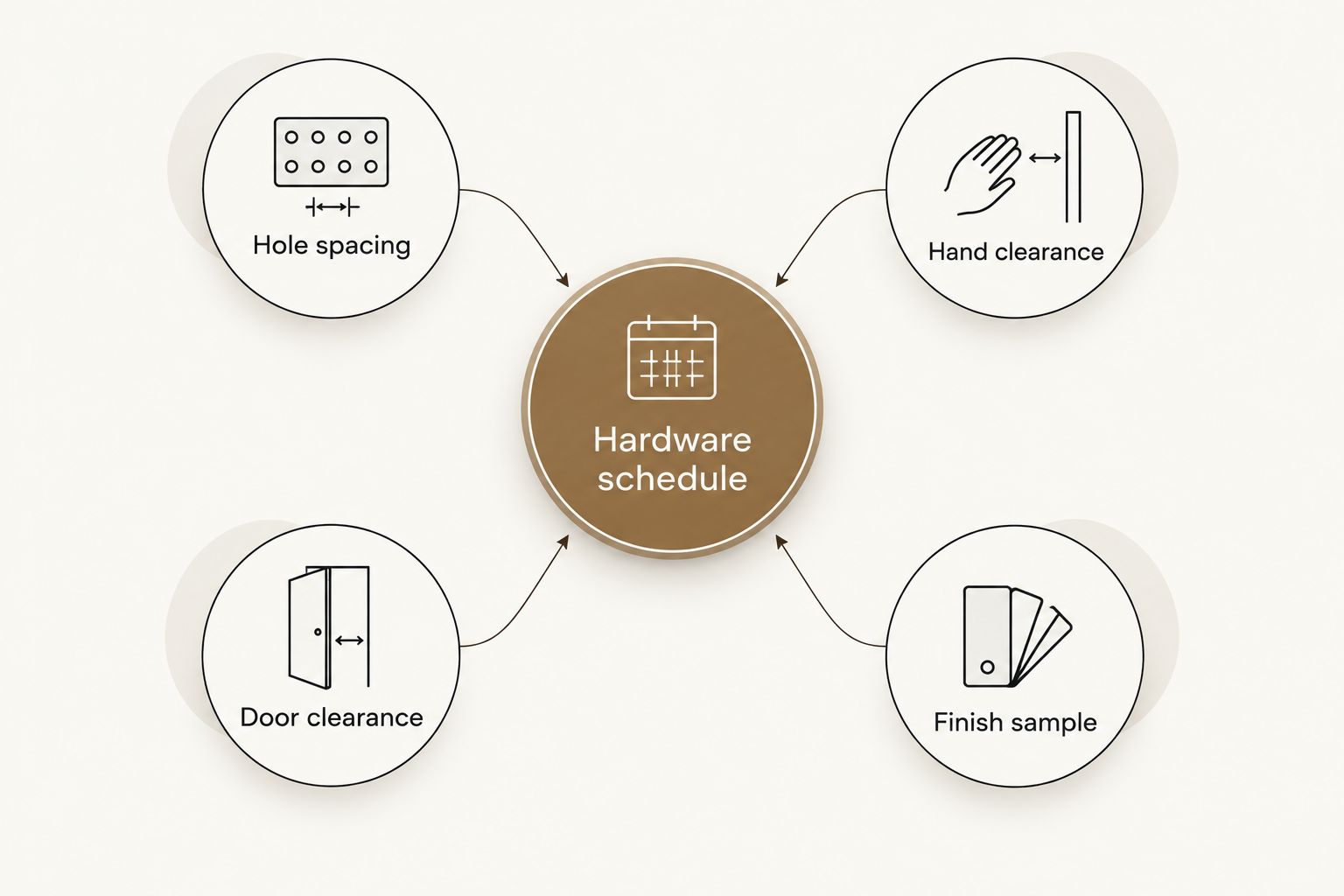
Record these checks on the cabinet drawing or hardware schedule:
- Hole spacing: Identify existing holes or the specified mounting pattern.
- Hand clearance: Check usable room behind the grip.
- Door clearance: Open neighboring fronts and inspect potential contact.
- Finish sample: Review the actual hardware beside the cabinet finish.
Check corner cabinets especially carefully. A pull can fit its own door yet interfere with the neighboring drawer when both are in use. Test appliance handles and dishwasher clearance as part of the same review.
In your 2026 project notes, label every measurement with its unit. Keep millimeters and inches explicit so a dimension copied between a supplier sheet and a cabinet drawing does not lose its meaning.
Choose the finish after the shape works
Use actual samples beside the cabinet door, countertop, and nearby metal fittings. Assess them under the kitchen's daylight and installed lighting; do not approve the combination from separate online photographs.
A finish name is not a durability specification. Ask for the hardware's base material, coating information, and care instructions. Do not assume that black, brass-colored, or brushed hardware performs a particular way because of its appearance.
You also do not need every visible metal to match exactly. Choose a clear relationship: repeat one finish on the cabinetry, then assess whether the faucet and lighting look intentional beside it. Keep the decision tied to samples rather than finish names alone.
How the styles are ranked
Simple bar pulls lead because their shape supports a full-hand grip and works across several cabinet opening types. The remaining styles earn distinct places for traditional drawers, compact doors, transitional details, flat-front cabinetry, and furniture-style accents.
This is a design-and-fit ranking, not a product test or a claim about finish longevity. Your final choice depends on the selected hardware's dimensions, construction, and fit against the actual cabinet fronts.
Which cabinet hardware should you choose?
Choose simple bar pulls if you want a clear starting point. Choose cup pulls for traditional drawer banks, round knobs for smaller doors, and edge pulls only when their attachment and grip have been planned with the cabinetry.
For a 2026 quote request to JB Woodworks LLC, send cabinet photographs or drawings, your preferred hardware style, and any existing hole measurements. Identify who supplies the hardware, who confirms compatibility, and who handles installation before commitments are made.
Use the contact page to describe the cabinetry scope and location. Include access constraints, surrounding renovation work, and any deadline the project team needs to review.
FAQ
What's the best cabinet hardware style for an Orlando kitchen?
Simple bar pulls are the default recommendation for an Orlando kitchen because they offer a full-hand grip and work across doors and drawers. Confirm projection, mounting centers, and neighboring clearances before selecting a particular pull.
Are knobs or pulls better for kitchen cabinets?
Pulls suit openings where you want a fuller hand grip, while knobs keep smaller doors visually compact. Test both with the people using the kitchen rather than deciding from appearance alone.
Can I replace cabinet handles without drilling new holes?
You can replace cabinet handles without new holes when the replacement matches the existing mounting pattern and fits the cabinet. Measure center-to-center spacing and check whether the new hardware exposes marks left by the old handle.
Should every kitchen cabinet have the same hardware?
Kitchen cabinets do not need identical hardware on every opening. A consistent finish and related shapes can connect door knobs, drawer pulls, and an island accent without forcing one handle onto every front.
Is black cabinet hardware better than brass-colored hardware?
Neither color establishes better durability or usability. Compare the specific hardware's material, coating, care instructions, grip, and appearance beside your cabinet sample.
Can I use edge pulls on existing cabinets?
Use edge pulls on existing cabinets only after confirming attachment, front thickness, and surrounding clearances. The selected pull's installation requirements determine whether cabinet preparation is needed.
What should I send with a custom cabinet hardware inquiry?
Send cabinet photographs or drawings, preferred hardware references, existing hole measurements, and the project location. For a JB Woodworks LLC custom cabinetry inquiry, also identify hardware supply responsibilities and surrounding installation work.
One last thing
Before approving drilling, ask for a handle to be positioned temporarily on a representative door and drawer. Open the neighboring fronts and use the grip from your normal standing position.
That small review checks something a finish board cannot: whether the hardware feels right on the cabinetry you will actually use.