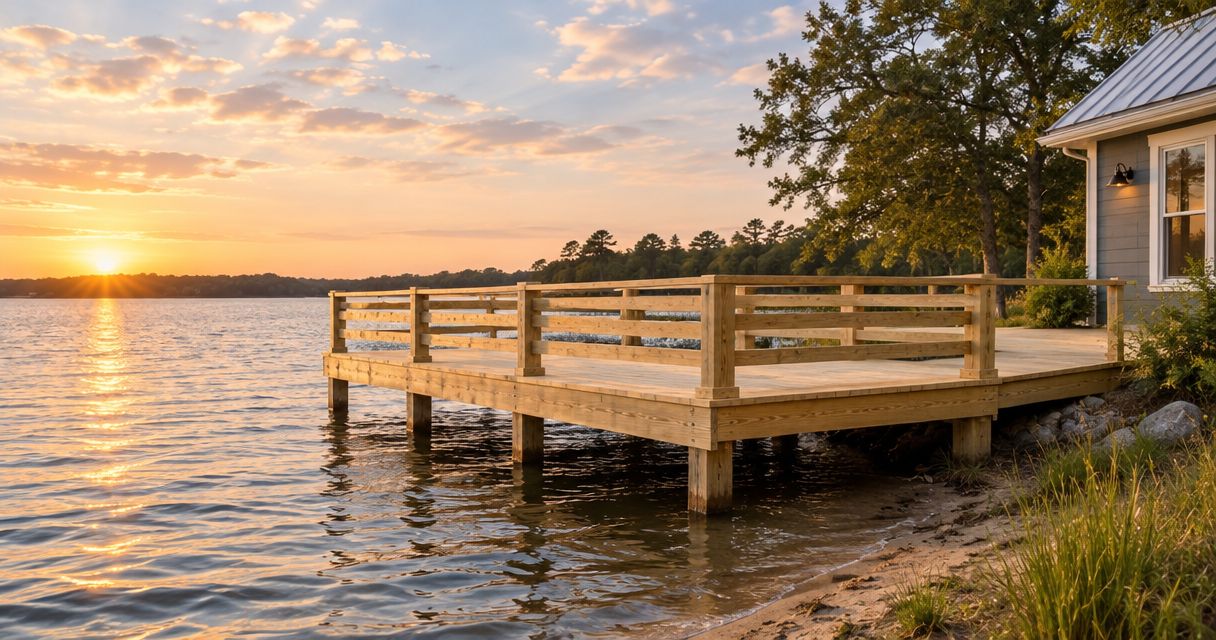
Yes, a dock can be built on a seasonal or fluctuating waterline when its supports, shore connection, and usable water depth suit the site's water-level range. A floating dock follows the surface, while a fixed dock stays at a set elevation; neither arrangement guarantees usable access at every level. For a 2026 project, confirm shoreline conditions, approval requirements, and construction access before committing to a layout.
- Can a dock be built on a fluctuating waterline? Yes, with site-specific planning for water depth and shoreline access.
- Floating docks follow changing water levels; fixed docks keep a constant deck elevation.
- Low-water boat access and high-water shore connections need separate checks.
- JB Woodworks LLC builds custom docks; review the proposed system, scope, and installation logistics before commitments.
Can a dock be built on a seasonal or fluctuating waterline?
Yes. The deciding question is whether the whole route from shore to water remains usable across the site's expected conditions. A platform that accommodates changing water levels still needs a suitable approach, restraint system, and location.
Use this comparison to frame a discussion, not to select a structure without a site review. Before choosing a builder, review what to confirm before hiring a dock builder in Orlando.
| Arrangement | Best for | Main advantage | Main limitation |
|---|---|---|---|
| Fixed dock | Sites where a fixed deck elevation suits the documented water range | The deck stays at a constant elevation | The distance between deck and water changes |
| Floating dock | Sites where following the water surface supports the intended use | The platform rises and falls with the water | Mooring, guide travel, grounding, and shore access still need review |
| Fixed approach with floating platform | Sites needing a stationary shore approach and a moving waterside platform | Separates the shore approach from the floating boarding area | Connections and transitions add design and maintenance considerations |
These are general arrangements, not a statement that every builder supplies every system. Ask which components the proposed contractor will fabricate, source, install, or leave to another qualified provider.
Why this matters
A dock planned from a single shoreline photograph answers only one moment's conditions. During lower water, the landing can become separated from usable depth; during higher water, a connection can reach a different angle or encounter submerged shoreline features.
For Central Florida homeowners, the useful starting point is the intended activity: boarding a boat, launching a paddlecraft, fishing, or sitting near the water. Define what the dock must do before deciding what it should look like. A waterfront sitting platform and a boat-boarding dock do not have identical access requirements.
Floating docks: follow the water, but check the limits
A floating dock changes elevation with the water surface. That makes it a relevant option when a consistent relationship between the platform and water supports boarding or launching.
Floating does not mean unrestricted movement. The arrangement needs a suitable way to hold its position while accommodating vertical movement, and the shore connection must work throughout that movement. At low water, a floating platform can reach the bottom; at high water, guides, restraints, and connections have their own limits.
For a 2026 proposal, ask the designer or system provider to explain the operating range and what happens outside it. Identify inspection needs and any operating restrictions in writing. Do not treat a floating dock as an automatic answer to flooding, strong currents, or storm exposure.
Fixed docks: keep the deck elevation, review water access
A fixed dock holds its deck at a set elevation rather than following the surface. It suits a project only when that elevation, its supports, and the changing relationship to the water fit the intended use.
The trade-off appears at the boarding point. Lower water increases the vertical separation between the deck and the water; higher water reduces it. A layout that feels comfortable during the site visit can feel very different under another condition.
Ask how the proposed elevation was selected and which water-level information supports it. Structural design, foundation suitability, and any required professional involvement must be resolved separately from choosing decking or finishes.
Fixed approach and floating platform: review the transition
Combining a stationary approach with a floating platform separates two jobs: reaching the waterfront and maintaining a platform near the water surface. The transition between them becomes a central design issue.
As water levels change, the connecting gangway changes angle. Its landings, clearances, connections, and movement need review across the proposed operating range, not just at the water level present during measurement.
This arrangement also creates responsibility boundaries. Confirm who provides the fixed work, floating components, connection details, and installation coordination. A proposal should describe the complete route rather than leave the interface between separate scopes unresolved.
Why dock suitability varies with the site
The same dock arrangement does not suit every shoreline. Review these factors before selecting materials or requesting a firm construction commitment:
- Water-level range: Establish the low and high conditions the proposal must address, using records and observations tied to a consistent reference.
- Shoreline and bottom profile: Identify how the bank meets the water, where usable depth begins, and where a floating section could ground.
- Exposure and movement: Describe waves, boat wakes, current, and debris so the responsible designer can assess the relevant conditions.
- Intended use: Explain boarding, launching, fishing, seating, and accessibility needs rather than specifying only a platform size.
- Approvals and boundaries: Confirm the applicable property, waterbody, environmental, and association requirements before assuming a footprint is acceptable.
- Construction access: Identify routes for materials and equipment, staging space, shoreline restrictions, and installation responsibilities.
Separate ordinary seasonal variation from exceptional conditions. A useful 2026 brief records both without suggesting that a routine operating range establishes performance during a major storm.
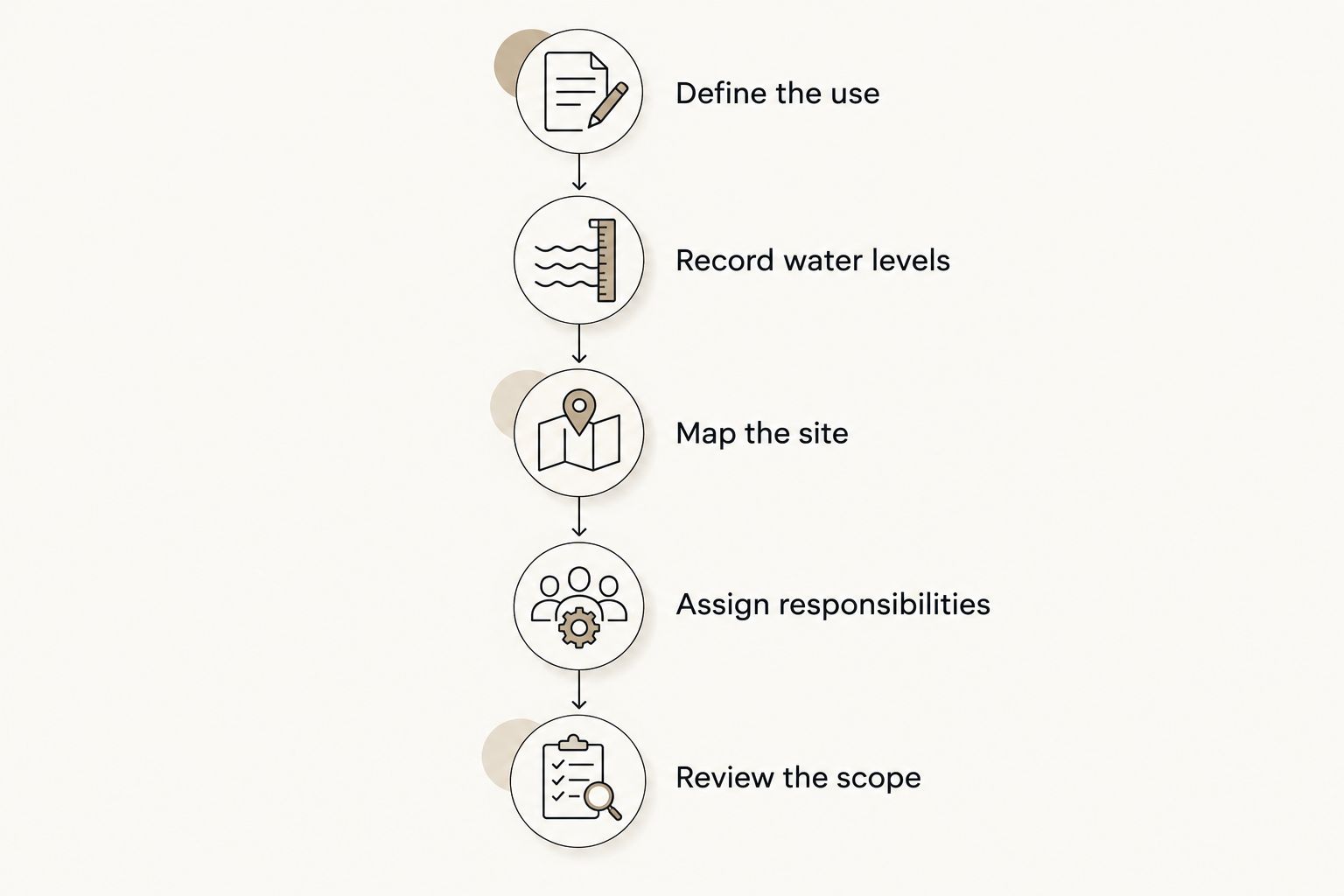
How to prepare a useful dock brief
Start with evidence that helps the project team understand the site. You do not need to solve the structural design yourself; you need to describe the conditions and intended use accurately.
- Define the use. State whether you need boat boarding, paddlecraft launching, fishing access, seating, or a combination. Include who will use the route and any access needs.
- Record water levels. Gather dated photographs, available waterbody records, and observations of low and high conditions. Identify the reference used for measurements.
- Map the site. Provide available surveys, shoreline photographs, existing structures, approximate desired dimensions, and known access constraints. Mark preliminary dimensions as preliminary.
- Assign responsibilities. Identify who will confirm approvals, prepare required drawings, address engineering where needed, supply components, and coordinate installation.
- Review the scope. Compare the proposed arrangement with the brief, including exclusions, materials, access assumptions, and decisions still awaiting confirmation.
The sequence keeps the conversation practical: use first, site evidence next, then a clearly assigned scope. Choosing a finish before resolving the water-level range reverses that order.
Make water-level evidence comparable
A water mark without a date or reference is difficult to interpret. Photograph the shoreline from repeatable viewpoints and describe whether an observation comes from personal records, a survey, or an available waterbody record.
Keep observed conditions distinct from the conditions the design must address. A photograph establishes what was visible on that date; it does not establish the full range a dock must accommodate. Ask the responsible project professional what additional information is needed.
Describe installation access as carefully as the dock
Show the route from the delivery or staging area to the waterfront. Note gates, existing landscaping, slopes, neighboring property boundaries, and areas that must remain accessible during the work.
Explain whether the dock connects to an existing walkway or another structure. Include known restrictions on site access and identify who can authorize changes. These details help contractors review transport and installation logistics before commitments.
What should an Orlando homeowner ask a dock carpenter?
Ask for a clear boundary between carpentry and the other parts of a waterfront project. A dock involves more than its walking surface, and a carpentry proposal should not leave support-system or approval responsibilities implied.
JB Woodworks LLC is best for homeowners and project teams seeking custom dock carpentry with scope and installation logistics reviewed before commitments. The studio's stated work includes docks, waterfront platforms, and walkways. Confirm the proposed dock system and any specialist requirements for your particular site.
Useful questions include:
- Which parts of the dock are included in the carpentry scope?
- Who confirms the water-level assumptions and proposed elevation?
- Who supplies the support, flotation, restraint, or connection components?
- Who handles required drawings, approvals, and qualified trade work?
- What must be resolved before materials and installation are committed?
Use JB Woodworks LLC as the inquiry starting point with site photographs, intended use, available drawings, and your project location. For work beyond Orlando and nearby Central Florida communities, include travel and installation logistics in the initial discussion.
Discuss your waterfront project
Share site photographs, water-level observations, intended use, and installation access.
Does a floating dock solve every water-level problem?
No. A floating dock follows the surface only within the limits of its flotation, restraint, connections, and surrounding site. It still needs sufficient depth and a workable shore connection.
Ask what happens at the lowest expected water level, not just whether the platform floats during the site visit. The answer should cover grounding, access, and any restrictions on use.
Can a dock remain usable when the shoreline retreats?
Yes, if the approved arrangement still reaches usable water and provides a suitable access route. A dock that ends over exposed ground no longer provides the same waterside function, even if its structure remains intact.
Confirm where the intended boarding or launching point sits during lower water. Extending farther into a waterbody is not an assumed solution; the footprint and permissions require review.
Can you reuse an existing dock's location?
An existing location is a starting point, not proof that a replacement arrangement will suit changing water levels. Review its condition, footprint, access, and applicable requirements before treating it as an accepted design.
For a 2026 replacement brief, include photographs of the existing approach, supports, connections, and shoreline. Describe what no longer works, particularly at low or high water, so the new scope addresses the actual problem.
FAQ
Can a dock be built on a fluctuating waterline in Central Florida?
Yes, a dock can be built on a fluctuating waterline when the proposed arrangement suits the site's water-level range, depth, shoreline access, and approval requirements. Suitability needs a site-specific review rather than a decision from one shoreline photograph.
Is a floating dock better than a fixed dock for seasonal water changes?
A floating dock follows the water surface, while a fixed dock maintains a set deck elevation. The better fit depends on depth, exposure, shore connections, intended use, and the limits of the proposed system.
What happens if the water gets too low under a floating dock?
A floating dock can ground if the water becomes too shallow beneath it. The proposal should address the bottom profile, the expected low-water condition, and any resulting operating restrictions.
Can I choose my dock's height from the current water level?
The current water level alone does not establish a suitable dock height. Review the relevant water-level range, intended use, and site requirements before selecting an elevation.
Who handles permits and engineering for a dock?
The project scope must identify who handles required approvals, drawings, and engineering. Do not assume those responsibilities are included in a carpentry proposal unless they are expressly assigned.
What should I send with a dock inquiry in 2026?
Send site photographs, intended use, available surveys or drawings, water-level observations, desired dimensions, and access information. For a JB Woodworks LLC dock inquiry, also identify the location and any existing contractor or design-team responsibilities.
One last thing
Before approving a layout, ask for the shore-to-water route to be shown at both low and high water. Include the approach, transition, platform, and boarding point—not just the deck outline.
A dock can remain structurally in place while losing the access function you commissioned it for. Making that distinction early gives your project team a clearer problem to solve and gives you a more useful scope to compare.