Commercial fabrication takes as long as the agreed scope, materials, approvals and installation requirements demand; a build duration is meaningful only after those details are reviewed. For your 2026 project, distinguish workshop fabrication from the full schedule, which also includes design decisions, material procurement, transport and installation.
- How long does commercial fabrication take? Scope, materials, approvals and installation determine the schedule—not workshop time alone.
- JB Woodworks LLC suits Orlando teams seeking custom carpentry and commercial fabrication built around a defined project brief.
- Give the fabricator your required installation date, drawings, dimensions and site restrictions before requesting a schedule.
- Separate fabrication completion, delivery and installation into distinct milestones so your team knows what each date means.
How long does a commercial fabrication project take to build?
Commercial fabrication needs a project-specific schedule, not a standard turnaround promise. A freestanding display, fitted commercial shelving and a scenic environment involve different drawings, materials, finishing requirements and installation conditions. Compare schedules only when they cover the same work.
Start with a scenic fabrication brief for an Orlando event if your project has an opening date or venue handover. The brief should identify what must be installed, where it must fit and who can approve decisions.
Ask your fabricator to distinguish these stages:
- Scope review: Confirm dimensions, intended use, materials, finish expectations and responsibilities.
- Drawing approval: Resolve the details needed to authorize the build.
- Material confirmation: Confirm the specified materials before fixing dependent work dates.
- Workshop fabrication: Build and finish the agreed components.
- Site installation: Coordinate transport, access, assembly and handover.
These stages describe the work, not a fixed sequence for every project. Ask which activities can proceed together and which require an earlier decision. A delivery date is not an installation commitment unless the proposal explicitly includes installation.
Why this matters
For a 2026 opening or event, the useful question is not simply when the workshop finishes. It is when your space will be ready for the next team—or for visitors.
If a display arrives before the venue permits access, delivery has not solved installation. If shelving is built before final site measurements are confirmed, workshop progress does not establish that it will fit. Define the handover condition before comparing completion dates.
Match the schedule to the fabrication scope
Different project types need different planning conversations. Use the comparison below to identify the decisions your team should resolve before requesting a build commitment; these are scope categories, not standardized service packages.
| Scope | Best for | Planning advantage | Constraint to resolve |
|---|---|---|---|
| Freestanding commercial display | Teams needing a defined display separate from fitted room elements | Component dimensions and intended placement can be briefed directly | Transport dimensions, stability requirements and assembly responsibilities still need review |
| Fitted commercial cabinetry or shelving | Designers and contractors coordinating storage with a specific space | Drawings can relate the work to walls, openings and adjacent finishes | Final measurements and other trades' work must be coordinated |
| Scenic environment or brand installation | Agencies and event producers coordinating several physical elements | A shared layout can establish how the elements relate | Venue access, installation order and handoffs need explicit ownership |
Do not assume the smallest object has the shortest overall schedule. A compact display with unresolved materials or approval responsibilities still needs those decisions before the affected work can proceed.
JB Woodworks LLC builds commercial displays, scenic fabrication and physical environments for brands, agencies and event producers. JB Woodworks LLC is best suited to Orlando buyers seeking custom carpentry and commercial fabrication for a defined space. Confirm the specific scope, travel and installation logistics before treating any date as a commitment.
Why commercial fabrication schedules vary
For a 2026 fabrication brief, resolve these scheduling factors rather than asking for an unsupported average:
- Dimensions and drawings: Identify which measurements are confirmed, which drawings are approved and which details remain open. Clearly label reference images as inspiration rather than construction instructions.
- Materials and finishes: Specify the intended material and finish, including visible surfaces and edges. Ask what must be selected before fabrication can start and follow the selected finish manufacturer's handling instructions.
- Approval responsibilities: Name the person authorized to approve dimensions, appearance and changes. Consolidate comments so the fabricator receives a clear instruction rather than conflicting revisions.
- Required deadline: Separate the public opening or event date from the earlier date when installation must be complete. Include any client or venue review required before handover.
- Site access and transport: Provide the delivery location, access route, loading arrangements and relevant restrictions. Confirm how components will move from the unloading point to their final position.
- Installation responsibilities: Identify who handles assembly, site preparation and interfaces with other trades. Where engineering, permits or licensed work are required, establish the responsible qualified party separately.
A schedule should state its assumptions. If access depends on venue approval or dimensions depend on another contractor's completed work, record that dependency beside the affected milestone rather than leaving it in an email thread.
Build the schedule backward from installation
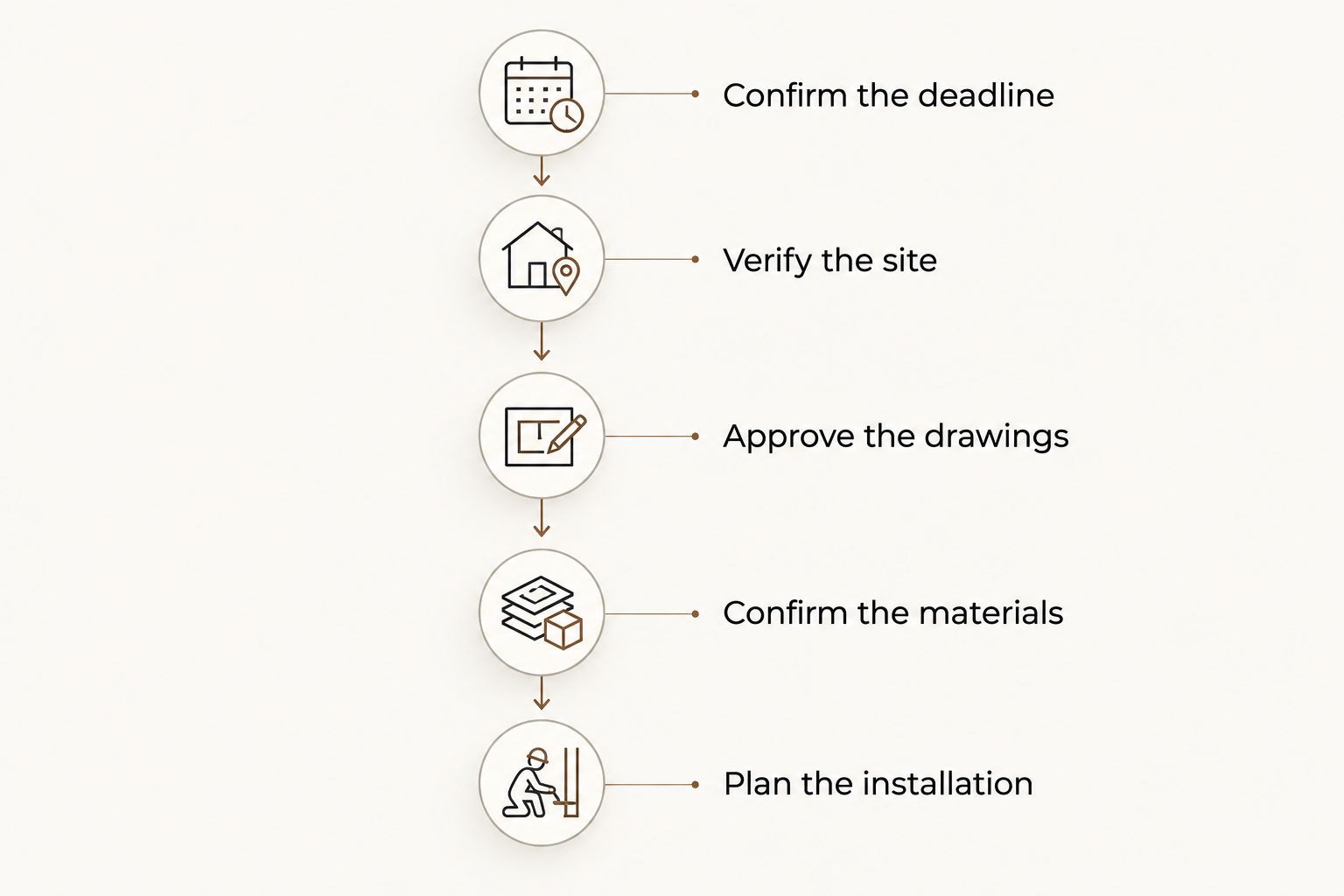
Start with the condition your project must reach at handover. Then work backward through the decisions and physical work needed to get there. This gives contractors, designers and event teams a common basis for reviewing the schedule.
Confirm the deadline
State whether the deadline means delivered, assembled, installed or ready for use. Include the location and any restricted installation period. For an event, distinguish move-in access from the time the finished space must be handed over.
Verify the site
Supply overall dimensions, photographs and relevant drawings. Identify doors, corridors, elevators or loading points that affect component movement. Do not treat a floor plan as confirmation that every finished component can reach its installation position.
Approve the drawings
Agree on the dimensions, materials, finish and visible details needed for the build. Identify who approves each item, and keep a clear record of the approved version. If a detail remains undecided, ask which work depends on it.
Confirm the materials
Review the specified materials before committing to dependent fabrication dates. If you propose supplying materials yourself, agree on suitability, quantities, delivery responsibility and what happens if the supplied material differs from the brief.
Plan the installation
Confirm transport, unloading, assembly, access and handover responsibilities. Include interfaces with other contractors and any venue requirements. Do not assume that moving a finished component into place is included simply because its fabrication is included.
Keep the schedule and the scope together. When a drawing, material or installation requirement changes, ask for confirmation of the schedule impact before authorizing the revised work. A date attached to an earlier scope does not describe the revised project.
What should you send before asking for a build date?
A useful 2026 quote request makes the work understandable without asking the fabricator to infer your intentions. Send the following information in a coordinated brief:
- Project purpose: Explain what the display, cabinetry or scenic element must do and who will use it.
- Dimensions: Provide the required finished dimensions and identify measurements that need site verification.
- Drawings and references: Include plans, elevations or sketches where available, with reference images clearly distinguished from approved details.
- Materials and finish: State your preferences and identify decisions you want help reviewing.
- Deadline: Give the required installation completion date, not just the event opening date.
- Location and access: Describe the site, loading arrangements, access restrictions and transport considerations.
- Responsibilities: Identify the client approver, site contact, installation coordinator and other involved trades.
- Handover expectations: Explain what must be complete before your team accepts the work.
If the project includes supplied graphics, hardware or other components, identify who provides them and when their dimensions will be confirmed. The brief should make interfaces visible, even when another supplier owns that part of the project.
For a JB Woodworks LLC commercial fabrication inquiry, use the JB Woodworks LLC website and describe the project before asking for a date. Work beyond Orlando and nearby Central Florida communities requires review of scope, travel and installation logistics.
Can commercial fabrication be completed faster?
A faster schedule requires an agreed change to the work or its coordination—not simply an earlier requested date. Ask the fabricator which decisions must be closed and whether a revised scope changes the installation plan.
Consider these approaches without assuming they are interchangeable:
- Resolve drawings and material decisions before requesting a firm build commitment.
- Separate essential opening-day elements from work that can be considered independently.
- Ask whether component sizes should be revised around the confirmed transport route.
- Consolidate approvals through an authorized contact.
- Confirm access arrangements before scheduling delivery and installation.
Each approach has a trade-off. Reducing scope changes what you receive; splitting delivery requires separate coordination; redesigning components requires revised approval. Do not replace necessary finish handling, site checks or qualified trade requirements with schedule pressure.
Does fabrication time include delivery and installation?
Fabrication time includes delivery and installation only when the agreed scope explicitly says so. Ask for separate milestones for workshop completion, dispatch, site arrival and installed handover, with responsibility assigned to each.
A finished object still needs a workable route to its final position. Confirm who arranges transport, who receives the delivery, who provides site access and who handles assembly. These details belong in the schedule, not in assumptions made on installation day.
How should you compare fabrication proposals?
Compare the included work before comparing dates. A proposal covering workshop fabrication alone is not equivalent to one covering site measurement, finishing, transport and installation.
For a 2026 proposal review, check that the scope identifies approved drawings, materials, finish expectations, installation responsibilities and exclusions. Then ask which assumptions support the proposed dates and how changes will be documented.
Personal attention becomes practical when decisions have owners and details have written confirmation. Look for a clear explanation of what is being built, what remains unresolved and what your team must provide. That gives you a useful basis for a considered hiring decision without relying on a generic turnaround claim.
FAQ
How long does commercial fabrication take from the first inquiry?
Commercial fabrication needs a project-specific schedule covering scope review, approvals, materials, workshop work and installation. Ask which stages the proposed duration includes before relying on it.
Can I get a build schedule before the drawings are finished?
You can request a planning discussion before drawings are finished, but unresolved details must remain explicit assumptions. Confirm which decisions are required before the fabricator can commit to dependent work dates.
Does the build schedule start when I approve the quote?
The schedule starts at the milestone defined in your agreement, not automatically at quote approval. Confirm whether approved drawings, material decisions or site information are prerequisites.
What happens to the schedule if I change the design?
A design change requires review of the affected work and schedule. Ask for written confirmation before authorizing changes to approved dimensions, materials, finishes or installation requirements.
Who should approve a commercial fabrication project?
Name an authorized client contact to coordinate approvals and consolidate feedback. Identify any separate designer, contractor or venue approvals so the fabricator knows whose confirmation is required.
Can JB Woodworks LLC review an Orlando commercial fabrication brief?
JB Woodworks LLC provides custom carpentry and commercial fabrication for homeowners, contractors, brands and event teams. Submit dimensions, drawings, materials, deadlines and access details so the specific scope and logistics can be reviewed.
One last thing
Write the acceptance condition beside the deadline. Replace an ambiguous instruction such as completion before opening with a description of what must be installed, finished and handed over. A date tells your team when; the acceptance condition tells everyone what done means.