Commercial fabrication for a retail space needs a project-specific quote; a useful 2026 budget starts with defined fixtures, dimensions, materials, finishes, delivery, and installation. Confirm those inclusions before comparing totals, because a fabrication-only quote does not establish the full cost of getting the finished work into your store.
- Commercial fabrication cost retail space: compare defined fixtures, materials, finishes, transport, and installation—not an unsupported average.
- JB Woodworks LLC builds commercial displays and scenic fabrication; discuss scope and installation logistics before commitments.
- Separate display fabrication from electrical work, engineering, approvals, and other qualified-trade responsibilities.
- Give every fabricator the same drawings, site information, deadline, and responsibility list before comparing proposals.
For Orlando retail teams considering JB Woodworks LLC, the useful starting point is a brief showing what needs to be built and where it must fit. Keep the creative references, physical requirements, and site constraints together.
How much does commercial fabrication cost for a retail space?
The meaningful comparison is the cost of the same defined scope, not the lowest headline total. For a 2026 retail project, request a breakdown that distinguishes the fabricated pieces from delivery, installation, and work assigned to others.
Use this structure to check what each proposal covers. A separately described item is easier to compare, revise, or remove without changing the rest of the brief.
| Scope component | What to define | What to check in the proposal |
|---|---|---|
| Drawings and development | Available plans, references, dimensions, and unresolved details | Which drawings or revisions are included |
| Fabrication | Fixture quantities, construction, materials, and visible details | Exactly which pieces will be built |
| Finishes | Color reference, sheen, visible surfaces, and sample requirements | Which preparation and finishing tasks are included |
| Transport | Destination, loading conditions, and access route | Who handles delivery and unloading |
| Installation | Placement, assembly, attachment, and site coordination | Which on-site tasks belong to the fabricator |
| Other responsibilities | Approvals, electrical connections, engineering, and adjacent work | Which tasks are excluded or assigned elsewhere |
Do not treat every blank as an inclusion. Ask for clarification before accepting the proposal, particularly where a fixture connects to the building or another contractor's work.
Why this matters
A retail display has to work as an object and as part of a store. Its dimensions affect circulation, its construction affects handling, and its installation depends on the actual site—not just the presentation drawing.
A rendering communicates appearance. It does not, by itself, define materials, construction details, attachment methods, or responsibility for connected services. Those decisions belong in the scope before you use a quote as a purchasing commitment.
For a 2026 opening or refresh, distinguish the date you need a proposal from the date the store must be ready. Design approval, fabrication, delivery, installation, and other trades need their own agreed handoffs; do not assume they are covered by a single completion date.
Which retail fabrication scope fits your project?
Different fixture types need different briefs. Compare the intended use first, then ask the fabricator to explain the proposed construction and installation approach.
| Scope option | Best for | Practical advantage | Limitation to resolve |
|---|---|---|---|
| Freestanding merchandise display | Retail teams arranging a defined display area | Can be planned as a distinct piece | Stability, handling, placement, and any required attachment still need review |
| Built-in shelving and casework | Stores fitting storage or displays to a specific wall | Can be designed around the measured space | Fit depends on existing conditions and adjacent work |
| Scenic feature or brand environment | Brands creating a particular physical setting | Supports a coordinated visual concept | References alone do not define construction, transport, or installation |
Choose the scope that serves the store's use, not the one with the simplest-looking sketch. A freestanding display still needs a handling plan; built-in casework still needs a site-fit plan; scenic work still needs a construction brief.
A combined project can include all of these elements. Identify each piece separately so a revision to the feature wall does not leave the shelving or checkout-area casework unclear.
Why commercial fabrication cost varies
These scope decisions determine what the fabricator must account for. Resolve them before asking different teams to price the same project.
- Dimensions and quantities. State overall height, width, and depth, along with the quantity of each fixture. Identify repeated pieces and pieces that only look similar.
- Materials and construction. Describe intended use, visible surfaces, edges, and attachment requirements. Ask the fabricator to identify the proposed materials rather than assuming a reference image specifies them.
- Finish requirements. Name the intended appearance, sheen, exposed faces, and sample approval process. Include surfaces customers touch and areas staff see during everyday use.
- Drawings and approvals. Distinguish approved details from ideas that still need development. Identify who can approve dimensions, materials, appearance, and changes.
- Site access and transport. Describe loading access, doors, lifts, stairs, route restrictions, and any building delivery rules. The assembled fixture must be considered alongside the route into the store.
- Installation and coordination. State who prepares the area, confirms existing conditions, completes related trade work, and accepts the finished installation.
For your 2026 brief, keep unresolved decisions visible. A clearly marked open question is more useful than a hidden assumption that later becomes a change request.
How do you prepare a retail fabrication quote request?
Send a coordinated brief rather than a folder of images without instructions. The goal is to make the intended work understandable while showing which details still need discussion.
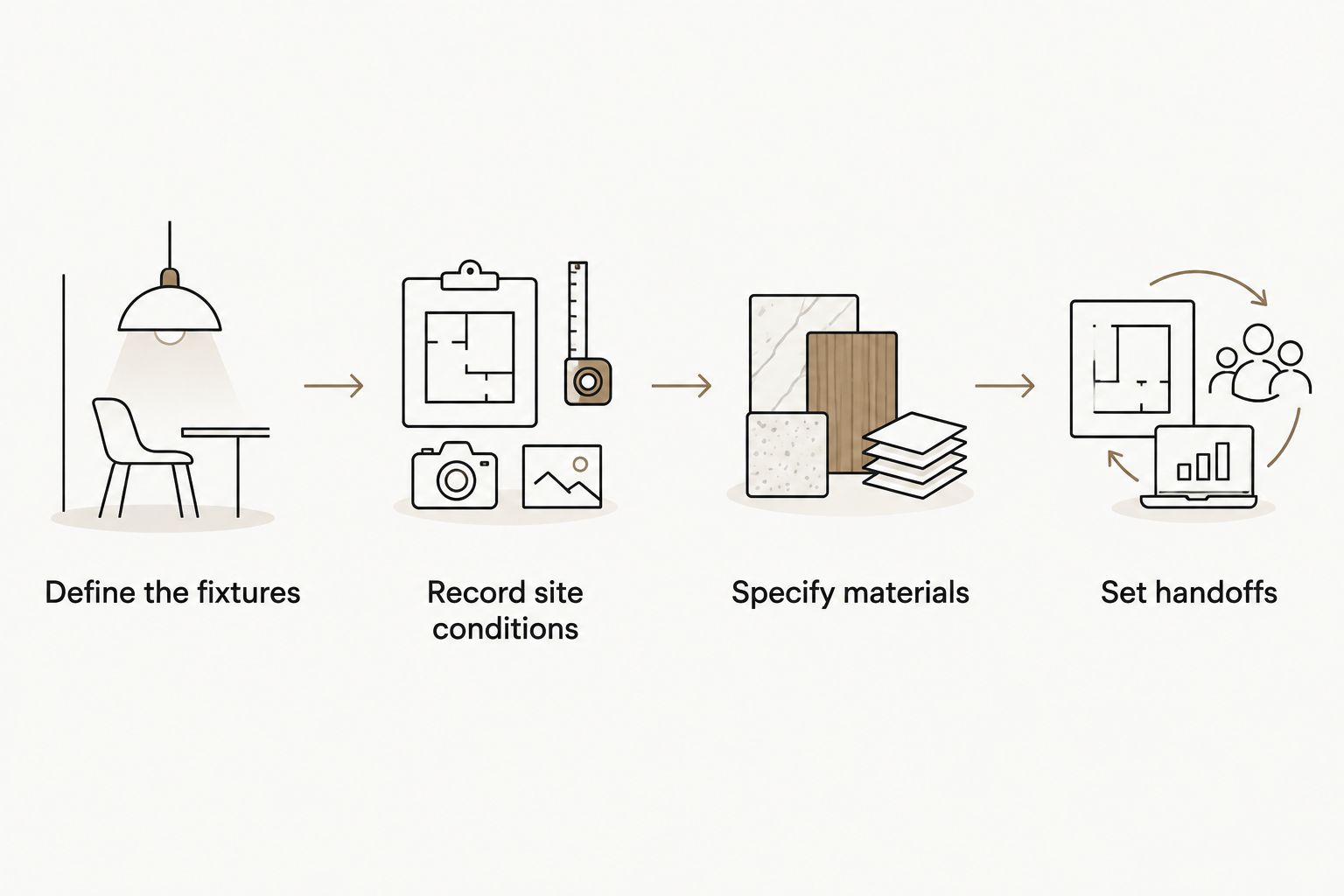
Define the fixtures
Create a fixture schedule naming each piece, its location, intended use, dimensions, and quantity. Use consistent names across drawings, reference images, and proposal comments so everyone discusses the same object.
Include product information that affects the fixture's use. For example, shelving needs a description of what it will hold; a display surface needs a description of how staff will arrange and access merchandise.
Record site conditions
Provide current photographs, available plans, and measurements. Identify walls, floor conditions, existing finishes, nearby fixtures, and any obstructions relevant to fit or access.
Label supplied measurements as preliminary until the responsible party confirms them. Make clear who verifies the site before fabrication proceeds; an image with a dimension written on it is not a substitute for an agreed verification process.
Specify materials
Describe the surfaces customers will see and touch, the intended finish, and any appearance references. Separate required details from preferences so the fabricator knows where an alternative is acceptable.
If you are supplying materials, say so in the initial brief. Ask who checks suitability, quantity, condition, and delivery arrangements before those materials become part of the proposed work.
Set handoffs
Name the person who approves the work, the person coordinating site access, and the parties responsible for adjacent tasks. Record the requested installation date and any building restrictions without assuming that a date is accepted until it is confirmed.
A useful brief also states what is not being requested. The guide to defining a custom carpentry scope in Orlando provides a related starting point for separating deliverables, exclusions, and handoffs.
How should you compare commercial fabrication proposals?
Read the scope before the total. Mark differences in quantities, materials, finishes, delivery, and installation, then request clarification on those differences before deciding which proposal fits.
Use the same revision of the brief for every fabricator. Otherwise, you are comparing different instructions rather than different responses to the same project.
Check these details side by side:
- Deliverables: Does each proposal name every fixture and its quantity?
- Construction: Does each describe the materials and the details that matter to appearance or use?
- Approvals: Is responsibility for drawings, samples, and final decisions clear?
- Site work: Are delivery, unloading, assembly, placement, and attachment addressed separately?
- Exclusions: Can you identify what another contractor or the store team must provide?
- Changes: Does the proposal explain how revised instructions will be reviewed before additional work proceeds?
Do not accept a substitution based only on a similar appearance. Ask what changes in construction, finish, handling, maintenance, or installation, and decide whether that difference suits the store.
Keep a dated proposal and the matching drawings together. For a 2026 project, that record should distinguish accepted decisions from later requests so the purchasing approval matches the work being built.
Where does custom commercial fabrication make sense?
Custom fabrication fits projects where the fixture needs to respond to a particular space, merchandise arrangement, or visual concept. The trade-off is the need to define those requirements and coordinate decisions before production.
JB Woodworks LLC is a fit for Orlando retail teams seeking custom commercial displays and scenic fabrication. Bring drawings, dimensions, materials preferences, deadlines, and installation information so the conversation starts with the actual project.
That does not establish that every part of a retail fit-out belongs in the same scope. JB Woodworks LLC's commercial fabrication work should be discussed alongside any separately required engineering, qualified trade work, building approvals, or contractor responsibilities—not treated as a substitute for them.
For sites beyond Orlando and nearby Central Florida communities, discuss location, scope, travel, transport, and installation logistics before commitments. Distance is part of the project brief, not a detail to leave until the work is ready to move.
Can you reduce the scope without losing the design?
Yes. Ask which details carry the design intent and which can change without affecting the fixture's purpose. Keep required dimensions, merchandise access, and essential site interfaces separate from optional decorative details.
Request clearly described alternatives rather than a general instruction to make everything cheaper. Compare what each alternative changes, including appearance, materials, construction, and installation responsibilities.
An alternative is useful only when you understand the trade-off. Removing delivery from a proposal, for example, does not remove the need to transport the work; it transfers that responsibility to someone else.
Does installation belong in the fabrication quote?
Installation belongs in the quote when it is part of the work you want the fabricator to provide. Ask for explicit wording covering delivery, unloading, assembly, placement, attachment, and coordination rather than relying on the word complete.
For occupied stores, also describe customer access, merchandise protection, and building work rules. Confirm who prepares the area and who decides it is ready for installation.
FAQ
What's the average commercial fabrication cost for a retail space?
A project-specific quote is the useful basis for a retail fabrication budget. Define the fixtures, dimensions, materials, finishes, transport, and installation before comparing proposal totals.
What should I send a commercial fabricator for a quote?
Send a fixture list, dimensions, site photographs, drawings or references, material preferences, and the requested deadline. Identify who approves details and who handles site access, installation, and related work.
Is built-in retail casework better than a freestanding display?
Built-in retail casework suits a defined location, while a freestanding display suits a separately planned display area. Compare site fit, stability, handling, storage needs, and installation responsibilities before choosing.
Does a fabrication quote include delivery and installation?
Delivery and installation are included only when the proposal explicitly lists them. Ask who unloads, assembles, positions, attaches, and accepts the finished work.
Can I use a rendering to get a final fabrication quote?
A rendering communicates appearance but does not define the entire fabrication scope. Confirm dimensions, materials, construction, finishes, site conditions, and responsibilities before treating a proposal as final.
Who handles electrical work or engineering for a retail display?
Assign electrical work and engineering to the appropriately qualified parties when required. Confirm those responsibilities separately rather than assuming a carpentry or fabrication proposal includes them.
Can JB Woodworks LLC discuss a retail fabrication project outside Orlando?
Work beyond Orlando and nearby Central Florida communities is subject to scope and logistics review. Provide the location, access conditions, transport needs, and installation requirements before seeking commitments.
One last thing
Check the route into the store before approving the fixture's assembled dimensions. Review the loading point, doorway clearances, turns, lifts, and final placement—not just the space where the display will stand.
Put that access review beside the drawings in your 2026 approval package. A fixture brief is not complete until the team understands both what gets built and how it reaches its intended position.